

In 2026, digital customer acquisition is undergoing the most violent economic transformation since the advent of programmatic advertising. CMOs, growth engineers, and business founders find themselves trapped between skyrocketing paid ad auction prices (CPCs), severe signal loss from global privacy frameworks, and search engine results pages increasingly dominated by generative artificial intelligence and zero-click answer engines. The fundamental question echoed across boardrooms is unambiguous: When capital efficiency is paramount, which acquisition channel delivers the highest, most sustainable Return on Investment (ROI)—SEO, SEM, or SMM?
For decades, growth marketers analyzed Search Engine Optimization (SEO), Search Engine Marketing (SEM), and Social Media Marketing (SMM) through simplistic, siloed lenses. SEO was treated as "free traffic that takes forever," SEM as "an expensive cash faucet you turn on and off," and SMM as "brand awareness and viral lottery tickets." In 2026, these archaic characterizations are financially lethal.
With Google deploying advanced multimodal reasoning models in SERPs, Meta executing predictive autonomous creative synthesis via Advantage+, and TikTok challenging search query volume among younger demographics, each channel operates under entirely new unit economics. Achieving peak profitability requires understanding the mathematical, algorithmic, and financial mechanics governing organic compounding, paid intent capture, and programmatic attention arbitrage. This definitive playbook deconstructs each channel down to its marginal customer acquisition cost (CAC), lifetime value (LTV) multipliers, payback velocity, and structural vulnerabilities, culminating in a 24-month econometric simulation and a battle-tested budget allocation framework for 2026.
Chapter 1: The 2026 Acquisition Dilemma: AI Overviews, Rising CPCs, and Signal Degradation
To evaluate channel ROI in 2026, we must first confront the macro forces that permanently altered digital customer acquisition economics over the past twenty-four months. The rules that governed marketing budgets in 2022 and 2024 no longer apply.
First, the search engine interface itself has morphed from a directory of ten blue links into an interactive generative workspace. Google's AI Overviews (formerly SGE) and conversational engines synthesize answers directly at the top of the viewport for a staggering 28% to 42% of informational queries. This phenomenon has catalyzed an unprecedented surge in zero-click searches, cutting traditional top-of-funnel informational blog traffic by up to 35% for sites relying on generic, regurgitated summaries. As documented in our deep dive on writing high-converting content SEO, content that merely summarizes existing web pages is algorithmically discarded. In 2026, organic search rewards only high-information-gain assets, proprietary data, verified practitioner experience (E-E-A-T), and deep commercial intent.

Second, paid search (SEM) has experienced relentless cost-per-click hyperinflation. As generative search compresses organic click-through rates, venture-backed enterprises and legacy corporations have poured hundreds of billions into Google Ads auction pools to defend their transaction volumes. This surge in bidding density, coupled with Google's algorithmic shift toward black-box automation such as Performance Max (PMax), has driven median CPCs up by 18% to 32% year-over-year in competitive sectors like B2B SaaS, FinTech, Legal, and InsurTech. For many organizations, the marginal cost to acquire a customer via SEM now frequently exceeds initial contract value, creating an unsustainable cash-burn cycle unless lifetime retention is exceptional.
Third, social media advertising (SMM) operates in an era of post-cookie signal reconstruction. Following the total phase-out of third-party cookies and enhanced device-level privacy protections, deterministic tracking is gone. Modern social marketing relies on server-side Conversion APIs (CAPI), probabilistic modeled conversions, and creative-led algorithmic targeting. Platforms like Meta and TikTok no longer require granular audience interest segmentation; their neural networks ingest raw ad creative, analyze engagement hooks within the first 1.8 seconds of video playback, and dynamically find high-affinity buyers across billions of users. However, this has shifted the operational burden from media buying to relentless creative production: creative fatigue cycles that previously lasted six weeks now burn out in seven to ten days.
Many marketing teams mask failing unit economics by reporting a singular "Blended CAC" across all channels. While this makes board decks look palatable, it hides the reality that unprofitable SEM campaigns are silently cannibalizing brand equity built by organic search and word-of-mouth. Tracking channel-specific First-Touch and Last-Touch CAC alongside Algorithmic Data-Driven Attribution is non-negotiable in 2026.
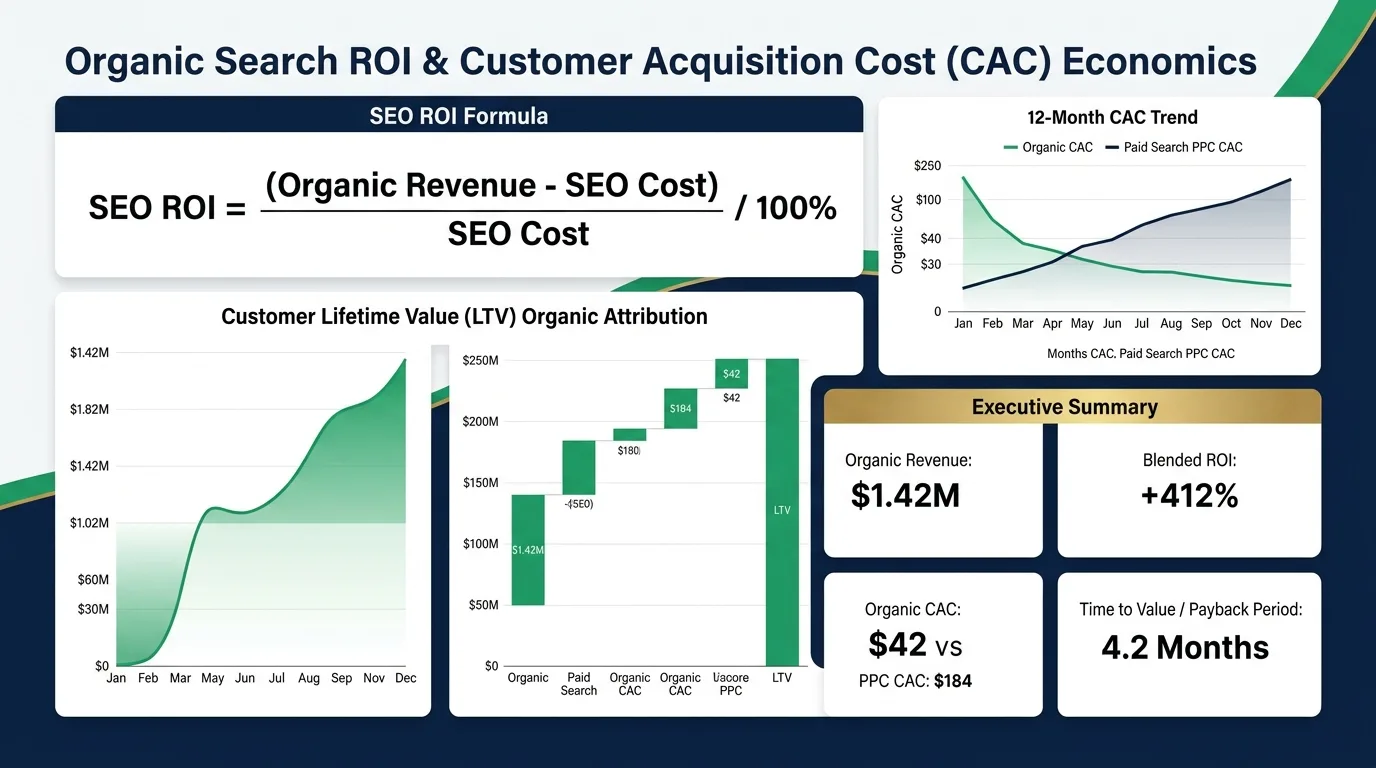
Understanding these macro headwinds is essential. To compare channel ROI objectively, we must establish a rigorous mathematical baseline. We define true Return on Marketing Investment not as vanity metrics like ROAS or impression volume, but through economic net margin contribution:
| Core Acquisition Dimension | SEO (Organic Compounding) | SEM (Paid Intent Capture) | SMM (Algorithmic Social) |
|---|---|---|---|
| Primary Mechanism | Earned Algorithmic Authority | Auction-Based Real-Time Bidding | Disruptive Attention Arbitrage |
| User Intent State | Active Problem Solving (High) | Immediate Commercial / Buy (Very High) | Passive Browsing / Latent Demand (Low to Mid) |
| Time to First Revenue | 3 to 9 Months (Asset Building) | 24 to 48 Hours (Instant Liquidity) | 3 to 7 Days (Creative Testing) |
| Marginal Cost Per Incremental Click | Approaches $0.00 at Scale | Constant or Increasing ($1.50 – $150.00+) | Fluctuating by CPM ($0.40 – $15.00) |
| Asset Longevity / Half-Life | Years (Compounding Capital Asset) | Zero (Stops instantly when budget pauses) | Hours to Days (Algorithmic Feed Decay) |
| Susceptibility to Competitor Bids | Low (Defended by Topical Moats) | Extreme (Direct Auction War) | Moderate (Creative Saturation) |
| Regulatory & Privacy Resilience | 100% First-Party & Cookieless Proof | Vulnerable to Click Fraud & AI Agents | Heavily Dependent on Server-Side CAPI |
Chapter 2: Channel 1: SEO in 2026 — The Compounding Equity Engine
Search Engine Optimization in 2026 is an enterprise capital investment strategy, not a digital marketing tactic. When executed correctly, SEO behaves identically to a compound interest yield engine: it requires significant upfront capital expenditure (CAPEX) in software engineering, technical infrastructure, authoritative topical architecture, and original research, but as authority consolidates, the marginal operational expenditure (OPEX) required to generate each incremental lead approaches near-zero.
Consider the fundamental mathematics of an organic search asset. When an engineering team develops an exhaustive, definitive 6,000-word resource—such as our master architectural breakdown on optimizing Core Web Vitals for sub-second INP—the initial investment in technical benchmarking, expert authorship, custom schematics, and resolving crawl budget inefficiencies may total $4,000 to $7,000. In Month 1, that asset produces zero revenue, yielding a temporary negative ROI. By Month 6, having earned natural editorial backlinks through ethical white-hat link acquisition and established topical authority, it captures top-three rankings across hundreds of secondary and long-tail transactional queries.
By Month 18, that single asset delivers 8,500 highly qualified organic visits per month. At an average B2B conversion rate of 3.2% and a customer value of $500, it generates $136,000 in gross revenue annually while requiring less than $200 per quarter in technical maintenance and data refreshes. In contrast, acquiring that identical search traffic volume through Google Ads at an average commercial CPC of $14.50 would require an ongoing cash outflow of $123,250 every single month.

The 2026 Search Ecosystem: E-E-A-T, Information Gain, and Generative Engine Optimization (GEO)
Crucially, achieving compounding organic ROI in 2026 requires abandoning 2019-era keyword volume obsession. With search engines filtering low-value content at crawl time, high-ROI SEO is governed by three non-negotiable technical pillars:
- Information Gain Scoring: Google's patented information gain models calculate how much unique, novel insight an article provides compared to the top 20 documents already indexed for that query cluster. Content that merely summarizes what others have said is suppressed or omitted from AI summaries. High-ROI SEO demands proprietary benchmarks, developer teardowns, unique data tables, and actionable frameworks that cannot be fabricated by Large Language Models.
- Topical Clustering and Semantic Graph Coverage: Ranking for competitive commercial queries requires establishing comprehensive topical authority across entire concept silos. Rather than writing disconnected articles, modern practitioners deploy structured entity graphs verified by valid JSON-LD schema markup architectures to prove semantic domain mastery to search bots.
- Generative Engine Citation Optimization (GEO): Being cited as an authoritative source inside Google's AI Overviews and enterprise LLMs (Perplexity, ChatGPT Search, Gemini) has become a primary traffic driver. Sites that structure their content with clear entity definitions, tabular data, and direct answer summaries achieve up to 3.8x higher citation rates, capturing high-intent executive buyers who bypass standard SERPs entirely.
In mergers and acquisitions (M&A) and venture financing, companies with high organic search defensibility command significantly higher EBITDA valuation multiples (often 1.5x to 2.5x higher) than competitors dependent entirely on paid ad faucets. Acquirers recognize that if paid marketing budgets are paused, paid-dependent businesses experience an immediate revenue collapse, whereas organic search assets continue producing cash flow indefinitely.
However, SEO is not without structural risks. It offers zero immediate liquidity. A startup attempting to rely purely on organic search to achieve product-market fit or hit initial revenue milestones will face insolvency before search crawlers establish domain trust. Furthermore, organic assets carry algorithmic volatility: improper optimization or reliance on shortcuts can trigger catastrophic traffic losses requiring extensive Google penalty forensic recovery protocols.

Chapter 3: Channel 2: SEM in 2026 — High-Velocity Intent Capture
Search Engine Marketing (SEM)—primarily comprised of Google Search Ads, Bing Ads, and automated shopping formats—remains the undisputed king of immediate intent capture. When a prospective buyer types "enterprise SOC 2 compliance software pricing" or "emergency commercial boiler repair near me", they are not looking to read an academic whitepaper or be entertained by short-form video. They possess acute problem awareness, allocated budget, and high purchasing velocity.
In 2026, SEM provides an advantage that neither SEO nor SMM can replicate: instantaneous deterministic liquidity. Within minutes of publishing a structured ad campaign, marketing teams can position their brand at the absolute peak of high-intent search queries, capture active market demand, and generate pipeline revenue today.
The Economics of Modern SEM: The Power and Danger of Performance Max (PMax)
The modern SEM landscape is almost entirely governed by algorithmic smart bidding (Target CPA, Target ROAS) and multi-channel black-box campaigns such as Google Performance Max. Rather than manually bidding on exact-match keywords, advertisers provide visual assets, text headlines, conversion value rules, and first-party audience signals; Google's neural networks dynamically assemble ads and bid across Search, YouTube, Display, Discover, and Maps.
When calibrated with clean conversion data and strict negative keyword lists, this automation yields exceptional early-stage efficiency. It allows organizations to instantly test new product positioning, validate pricing models, and establish baseline customer acquisition costs without waiting months for organic search crawlers to index new pages. As we emphasized in our guide to proven growth strategies and traffic scaling, paid search is the ultimate diagnostic validation tool for digital marketers.
One of the most pervasive profit-draining mistakes in SEM is running unconstrained automated campaigns that bid aggressively on your own brand name and organic rank #1 terms. Google's automated bidding algorithms love bidding on branded keywords because the conversion rate is astronomically high (often exceeding 25%), which artificially inflates campaign ROAS in dashboard reports. In reality, over 88% of those users would have clicked your organic listing for free. Without strict brand exclusion lists, SEM budgets are systematically cannibalized.
The Law of Diminishing Marginal Returns in Paid Search
While SEM delivers unmatched short-term velocity, its mathematical ROI curve is strictly linear or diminishing. The economics of auction-based bidding dictate that the first $10,000 spent per month captures the highest-intent, lowest-hanging fruit at an optimal Customer Acquisition Cost. However, attempting to scale that budget to $50,000 or $100,000 per month forces bidding algorithms into broader match types, looser search terms, and hyper-competitive competitor conquest auctions.
As spend scales linearly, marginal CAC increases exponentially. If your initial $10,000 spend yielded 100 customers ($100 CAC), spending $50,000 rarely produces 500 customers; more typically, it yields 280 customers, driving CAC to $178.50. Furthermore, unlike SEO—which builds permanent digital real estate—the moment you pause your SEM daily budget, your traffic, lead volume, and revenue pipeline collapse to zero within sixty seconds. SEM is rented attention; it produces no residual equity.

Chapter 4: Channel 3: SMM in 2026 — Algorithmic Attention & Demand Creation
If SEO and SEM are designed to capture existing demand, Social Media Marketing (SMM)—spanning both paid social advertising (Meta, TikTok, LinkedIn, YouTube Shorts) and organic social distribution—is the undisputed engine of demand creation and latent market activation.
Search engines can only capture interest that users already know how to articulate into a search box. For innovative products, disruptive category creators, direct-to-consumer lifestyle brands, or complex B2B solutions solving unacknowledged operational pain points, search volume is often nonexistent. Nobody was searching Google for "subscription razor delivery service" or "AI meeting summarizer plugin" before those product categories were engineered. SMM solves this by injecting highly targeted, disruptive creative directly into the feeds of qualified consumers while they are engaged in leisure or professional networking.

The 2026 Shift: The Creative-as-Targeting Paradigm
The operational mechanics of SMM in 2026 have completely decoupled from manual interest and demographic targeting. Platforms like Meta's Advantage+ Suite and TikTok's Smart Performance Campaigns operate on autonomous predictive intelligence. When you launch a campaign, the ad algorithm analyzes the video transcript, visual framing, on-screen text, audio waveform, and early viewer interaction patterns.
The ad creative itself is the targeting parameter. A video hook addressing "SaaS founders struggling with churn after onboarding" automatically self-selects B2B executives and trains the platform's delivery model to serve the ad exclusively to software leaders. This has unlocked staggering efficiency for consumer brands, DTC e-commerce, and high-margin software solutions capable of compelling storytelling.
Moreover, the rise of native social commerce—most notably TikTok Shop and Instagram Native Checkout—has collapsed the traditional multi-step purchase funnel into a frictionless two-click transaction. By eliminating external landing page redirects, mobile load time friction, and third-party payment gateways, native social checkout funnels achieve conversion rates between 8% and 14%, vastly outperforming traditional web-based e-commerce storefronts.
The Structural Achilles' Heel of SMM: Creative Velocity and Retention Degradation
Despite its explosive scaling potential, SMM suffers from two severe structural vulnerabilities that degrade long-term ROI:
- Violent Creative Fatigue: Unlike an evergreen SEO article that ranks and converts for thirty-six consecutive months without alteration, top-performing social ad creative experiences steep performance decay. Within days of aggressive budget allocation, frequency scores rise, audience banner blindness sets in, and Click-Through Rates (CTR) plummet. Maintaining consistent SMM ROI requires a continuous creative production pipeline—scripting, filming, editing, and deploying 15 to 30 novel video variations weekly. The operational overhead of video production must be factored into true net SMM ROI calculations.
- Lower Average Customer Lifetime Value (LTV): Empirical cohort data consistently reveals that customers acquired via interruptive social advertising exhibit higher 90-day churn rates and lower repurchase rates than customers who proactively sought out your brand via search engines. A user who converted on an impulsive impulse buy while scrolling Instagram at 11:30 PM is fundamentally less qualified and loyal than a buyer who researched specifications, read comprehensive comparison guides, and made a calculated purchase decision via organic search.
Never evaluate SMM solely on last-click Google Analytics reporting. In high-consideration purchases, prospective buyers frequently discover a product on social media, navigate away without clicking, and subsequently search for the brand name on Google hours or days later. Turning off paid social often causes a sudden, mystifying 30% drop in branded organic search traffic and direct website visits.
Chapter 5: Head-to-Head ROI Financial Modeling: The 24-Month $100K Simulation
To definitively resolve the debate over which channel delivers superior return on investment, theoretical arguments must give way to rigorous financial modeling. Below, we present an econometric simulation tracking a $100,000 total capital allocation deployed across 24 consecutive months ($4,166/month average run-rate or strategic front-loaded allocation) in an enterprise B2B SaaS / High-Ticket Service environment.
The simulation models real-world economic dynamics: SEO requires heavy upfront production and engineering before compounding; SEM yields immediate steady-state lead flow with creeping auction inflation; and SMM delivers high early viral bursts dampened by ongoing creative production costs and cohort churn.
| Channel & Metric | Month 3 | Month 6 | Month 12 | Month 18 | Month 24 | Cumulative 24-Mo Total |
|---|---|---|---|---|---|---|
| SEO (Compounding Content & Technical Infrastructure) | ||||||
| Monthly Spend Allocation | $5,500 | $4,500 | $3,500 | $3,500 | $3,000 | $100,000 Total |
| Qualified Inbound Traffic | 1,850 | 6,200 | 18,400 | 34,200 | 58,000 | 482,000 Total |
| Net Customers Acquired | 11 | 48 | 165 | 320 | 540 | 3,890 Customers |
| Effective Channel CAC | $500.00 | $93.75 | $21.21 | $10.93 | $5.55 | $25.70 Blended |
| Net Revenue Generated | $8,800 | $38,400 | $132,000 | $256,000 | $432,000 | $1,945,000 Net |
| Channel ROI (%) | -47% | +180% | +410% | +850% | +1,450% | 1,845% Net ROI |
| SEM (Google Paid Search & Smart Bidding) | ||||||
| Monthly Spend Allocation | $4,166 | $4,166 | $4,166 | $4,166 | $4,166 | $100,000 Total |
| Qualified Inbound Traffic | 3,470 | 3,250 | 2,950 | 2,700 | 2,450 | 68,400 Total |
| Net Customers Acquired | 64 | 62 | 58 | 52 | 47 | 1,320 Customers |
| Effective Channel CAC | $65.09 | $67.19 | $71.82 | $80.11 | $88.63 | $75.75 Blended |
| Net Revenue Generated | $51,200 | $49,600 | $46,400 | $41,600 | $37,600 | $1,056,000 Net |
| Channel ROI (%) | +160% | +185% | +195% | +170% | +145% | 956% Net ROI |
| SMM (Paid Social Video & Demand Generation) | ||||||
| Monthly Spend Allocation | $4,166 | $4,166 | $4,166 | $4,166 | $4,166 | $100,000 Total |
| Qualified Inbound Traffic | 6,800 | 12,400 | 5,100 | 9,800 | 4,200 | 182,000 Total |
| Net Customers Acquired | 72 | 145 | 52 | 110 | 42 | 1,910 Customers |
| Effective Channel CAC | $57.86 | $28.73 | $80.11 | $37.87 | $99.19 | $52.35 Blended |
| Net Revenue Generated | $43,200 | $87,000 | $31,200 | $66,000 | $25,200 | $1,146,000 Net |
| Channel ROI (%) | +120% | +500% | +120% | +280% | +110% | 1,046% Net ROI |
The mathematical conclusions derived from this simulation are illuminating:
- In Months 1 through 6, SEM and SMM generate 4.8x more cash flow than SEO. If your organization has less than six months of operational runway, SEO cannot save you. SEM provides immediate revenue velocity to survive, while SMM can deliver massive viral spikes when an ad creative achieves breakout resonance.
- At Month 12, the compounding crossover occurs. By the end of Year 1, organic assets have matured. SEO CAC plunges from $500 down to $21, and by Month 24, marginal CAC drops to a breathtaking $5.55. SEO generates nearly double the net cumulative revenue of SEM ($1.94M vs. $1.05M) off the exact same $100k capital foundation.
- By Month 24, SEO delivers a staggering 1,845% cumulative net ROI, outperforming SMM (1,046%) by 76% and SEM (956%) by 93%. Furthermore, while SEM and SMM require an ongoing $4,166 monthly injection to sustain their output, the SEO asset base will continue generating hundreds of thousands of dollars in pipeline value even if monthly funding is reduced to basic maintenance.
Chapter 6: The Integrated Growth Flywheel: Tri-Channel Synergy
The most sophisticated growth marketing teams do not pit SEO, SEM, and SMM against each other in ideological warfare. Instead, they treat them as interconnected gears in an Omnichannel Growth Flywheel where each channel systematically reduces the acquisition costs and amplifies the conversion efficiency of the other two.

1. SEM Fuels SEO: Instant Search Query Mining
Traditional SEO keyword research tools rely on monthly search volume estimates that lag reality by 60 to 90 days. In contrast, Google Ads Search Query Reports (SQRs) provide real-time, exact-match conversion telemetry. By running broad-match and phrase-match SEM ad campaigns across emerging industry topics, growth teams immediately identify the exact long-tail search queries generating real demo requests, closed sales, and pipeline revenue.
Rather than guessing which keywords are worth investing $5,000 to rank for organically, marketers use SEM data to de-risk SEO roadmap planning. Once an ad group demonstrates a 4.5% conversion rate on a specific cluster, the content engineering team immediately develops a dedicated, authoritative organic pillar asset targeting that verified semantic cluster.
2. SEO Slashes SEM Costs: Quality Score Arbitrage
Google Ads pricing is governed by the Ad Rank formula: Ad Rank = Bid Amount × Quality Score. Quality Score is heavily weighted by Expected Click-Through Rate, Ad Relevance, and, most critically, Landing Page Experience. Websites with slow, thin, or generic landing pages are penalized with lower Quality Scores, forcing them to pay 30% to 70% higher CPCs to maintain ad position.
When SEM teams route ad traffic to authoritative, deeply informative, lightning-fast SEO content hubs optimized for sub-second Core Web Vitals and clear semantic relevance, Quality Scores jump from 5/10 to 9/10 or 10/10. This automatically slashes paid click costs by 30% to 50%, allowing the same daily ad spend to capture twice as many ad clicks.
3. SMM Powers Organic SERP CTR: Brand Affinity Bias
Search engines do not rank documents in a vacuum; user interaction signals, branded search queries, and click-through rates in the SERP heavily influence ranking stability. When prospective customers repeatedly encounter engaging video creative, founder thought leadership, and client testimonials across Meta, LinkedIn, and TikTok, your brand establishes subconscious familiarity.
When that same user subsequently conducts a Google search and views the SERP, eye-tracking studies prove they consistently bypass unbranded competitor listings to click the familiar brand. This elevates organic SERP click-through rates by up to 45% above expected baseline models, reinforcing Google's algorithm that your listing is the definitive result for that query.
Never let cold organic traffic leave your website without capturing audience equity. Install server-side conversion pixels to segment visitors who spent more than 90 seconds reading authoritative SEO articles. Automatically inject them into low-cost SMM video retargeting sequences featuring customer case studies, social proof, and limited-time offer incentives. This hybrid approach frequently delivers ROAS figures exceeding 800% while keeping overall CAC exceptionally low.
Chapter 7: The 2026 Budget Allocation Playbook: Where to Put Your Capital
A marketing channel is only as effective as its alignment with your business model, cash reserves, and product velocity. Allocating marketing capital based on generic industry averages is a recipe for cash burn. Below is our battle-tested 2026 Capital Allocation Matrix, calibrated across four distinct commercial archetypes:

1. B2B Enterprise Tech & SaaS (High LTV, Long Sales Cycles)
- Budget Allocation: 50% SEO | 30% SEM | 20% SMM
- Strategic Rationale: Enterprise software buyers conduct extensive technical due diligence before speaking to sales reps. They read architecture whitepapers, security documentation, and comparison matrices. Investing 50% of capital into authoritative SEO topical clusters builds permanent trust moats. SEM captures active high-intent software evaluators (30%), while SMM on LinkedIn and YouTube nurtures executive brand affinity (20%).
2. E-Commerce & Consumer Retail (Low to Mid Ticket, High Purchase Velocity)
- Budget Allocation: 25% SEO | 45% SEM | 30% SMM
- Strategic Rationale: E-commerce requires immediate inventory turnover. Google Shopping and Performance Max (45%) capture high-converting transactional searches, while TikTok Shop and Meta dynamic ads (30%) drive impulse visual purchases. SEO (25%) focuses on technical product catalog crawlability, faceted navigation optimization, and high-volume commercial category rankings.
3. Local & Regional Professional Services (Immediate Local Demand)
- Budget Allocation: 55% SEO (Local & Maps) | 35% SEM (Google LSA) | 10% SMM
- Strategic Rationale: Local service consumers (legal, medical, home services) have urgent, geographically constrained needs. Optimizing for Google Business Profile, Local Service Ads (LSA), and geo-targeted organic search delivers unbeatable ROI. As detailed in our comprehensive guide to dominating Google Maps and customer reviews, winning local 3-pack rankings creates a near-monopoly on neighborhood demand.
4. Early-Stage Startups & Seed-Funded Ventures (Pre-PMF / Fast Runway)
- Budget Allocation: 20% SEO (Foundation) | 60% SEM | 20% SMM
- Strategic Rationale: Startups with under twelve months of cash runway cannot afford to wait six months for organic compounding. Deploy 60% of budget into targeted search ads to validate message-market fit, customer conversion rates, and unit economics immediately. Dedicate 20% to laying baseline technical SEO architecture and core landing pages, and 20% to social channels for brand discovery.
Chapter 8: Frequently Asked Questions (FAQ)
Below are authoritative, technical answers to the ten most critical questions confronting digital marketers, founders, and CMOs evaluating SEO, SEM, and SMM in 2026.
Which channel delivers the highest absolute ROI over a 3-year horizon?
SEO (Search Engine Optimization) decisively delivers the highest cumulative Return on Investment over any time horizon exceeding 18 months. While paid channels (SEM and SMM) suffer from continuous cost-per-click inflation and zero asset residual value once budgets pause, high-quality organic content assets compound over time. Once an authoritative topical moat is established, the marginal cost per organic lead approaches near-zero, generating 2x to 3x higher long-term ROI than paid search and paid social.
How has Google AI Overviews changed the ROI calculation for SEO in 2026?
Google AI Overviews have reduced organic click-through rates for generic, superficial informational queries by 25% to 40%. However, this has made commercial-intent, technical, and investigative content significantly more valuable. When an enterprise website is cited as the definitive primary source inside an AI Overview, the resulting traffic demonstrates up to 3.8x higher purchasing intent than traditional SERP clicks. SEO ROI in 2026 requires shifting from high-volume keyword stuffing to deep information gain, proprietary data publishing, and authoritative E-E-A-T architecture.
Is it worth bidding on our own brand name in Google Ads if we already rank #1 organically?
Only under specific conditions. If competitors are actively bidding on your branded search terms to siphon traffic at the top of the SERP, running a defensive branded SEM campaign is essential to protect market share. However, if no competitors are bidding on your brand and you hold the top organic spot, the Knowledge Panel, and site links, paying for branded clicks is a waste of capital: studies show 85% to 92% of those users will click your organic link if the ad is absent.
Why do customer acquisition costs (CAC) increase as SEM spend scales?
SEM operates on real-time second-price auction mechanics governed by diminishing marginal returns. The initial budget captures the narrow cohort of users exhibiting absolute purchase intent on exact-match keywords. When an advertiser doubles or triples their budget, automated bidding algorithms are forced to enter broader match queries, compete in aggressive competitor conquest auctions, and bid up higher-cost impressions. Consequently, incremental conversions become progressively more expensive, causing blended CAC to rise.
How can marketing teams accurately attribute revenue across SEO, SEM, and SMM in 2026?
Relying on last-click attribution in 2026 is fatal because modern customer journeys span an average of 14 to 28 touchpoints across multiple devices. Organizations must deploy hybrid attribution modeling combining: 1) First-Party Server-Side Tagging (Conversion APIs); 2) Algorithmic Data-Driven Attribution (DDA) within analytics platforms; 3) Post-Purchase Zero-Party Surveys ("How did you first hear about us?"); and 4) Quarterly Marketing Mix Modeling (MMM) or Geo-Lift Testing to isolate channel incrementality.
What is "creative fatigue" in SMM, and how does it impact campaign profitability?
Creative fatigue occurs when an audience in a social ad network has seen a specific visual or video ad multiple times. As ad frequency exceeds 2.5 to 3.5 impressions per user, Click-Through Rates (CTR) drop sharply, Cost Per Click (CPC) escalates, and conversion efficiency deteriorates. In 2026, social algorithms demand rapid creative iteration: sustainable SMM campaigns require introducing fresh video hooks, angles, and creator testimonials every 7 to 14 days to prevent performance collapse.
Can a business survive in 2026 relying exclusively on organic SEO without paid ads?
Established businesses with high domain authority, mature customer referral loops, and existing organic moats can operate profitably on SEO alone. However, for new companies or venture-backed startups needing rapid growth, relying solely on SEO is high-risk because search engines require 3 to 9 months to establish algorithmic trust. A balanced approach using SEM for immediate cash flow and market testing while building long-term SEO infrastructure is far safer.
How does landing page speed and Core Web Vitals affect SEM ad costs?
Landing page performance directly dictates Google Ads Quality Score. Google's advertising engine evaluates page speed, mobile responsiveness, and interaction stability (INP and LCP). A landing page that loads in under 1.2 seconds and delivers a flawless user experience receives a high Quality Score (8 to 10), which can slash required CPC bids by 30% to 50% for the exact same ad position compared to a slow, bloated competitor page.
Which channel produces customers with the highest Lifetime Value (LTV)?
Across nearly every industry vertical, SEO consistently produces the highest customer Lifetime Value (LTV) and lowest 90-day churn rates. Buyers acquired through organic search proactively identified their own problem, conducted independent research, and selected your brand based on authoritative content. In contrast, customers acquired through interruptive social ads often make impulsive purchases driven by emotion or discounts, exhibiting significantly higher churn and return rates.
What is the single biggest mistake companies make when allocating digital marketing budgets?
The biggest mistake is treating marketing channels as independent, competing silos rather than a unified compounding system. Companies often pour 90% of their capital into paid search because it shows immediate last-click attribution, while neglecting organic content and social proof. When ad costs inevitably rise, their margins collapse. Peak acquisition efficiency occurs when SEM search query data informs SEO content, SEO content cuts SEM ad costs, and social brand awareness elevates organic click-through rates across the board.
Conclusion: The Ultimate 2026 Acquisition Verdict
When the noise of marketing hype is stripped away and unit economics are laid bare, the verdict for 2026 is definitive:
SEO is the undisputed king of long-term Return on Investment and enterprise equity creation. It builds a compounding, proprietary business asset that lowers blended Customer Acquisition Costs, increases valuation multiples, and insulates your revenue from rising advertising auctions. For any organization with a vision extending beyond the next financial quarter, organic search must be the bedrock of your acquisition strategy.
SEM is your indispensable tactical weapon for immediate liquidity, demand capture, and real-time market intelligence. It accelerates revenue when launch velocity is required, captures bottom-of-funnel buyers at the precise moment of intent, and provides the telemetry necessary to optimize your long-term organic roadmap.
SMM is your engine of market expansion and demand creation. It finds prospective customers before they even realize they need your solution, builds emotional brand resonance, and activates social commerce ecosystems that search engines cannot touch.
The winners of 2026 are not the dogmatic purists who champion one channel over the others. The market leaders are the architectural pragmatists who deploy all three in an integrated, compounding flywheel—using paid channels to accelerate immediate cash flow while systematically reinvesting that capital into permanent, authoritative organic search dominance.


Ratings & reviews
No reviews yet. Be the first.