
SEO success is not simply ranking higher on Google. A page can reach position one and generate little business value, while another page ranking lower can consistently attract qualified visitors, generate leads, drive sales, and strengthen a website's overall search visibility.
In 2026, measuring SEO has become even more nuanced. Search results increasingly include richer SERP features, AI-powered search experiences, and multiple ways for users to discover information. Google Analytics also treats traffic from non-ad search experiences, including AI Overviews and AI Mode, within organic search.
That means traditional metrics such as rankings, impressions, and organic traffic are still useful, but they are no longer enough on their own.
A better SEO measurement framework connects search visibility to what happens after the click.
In practical terms:
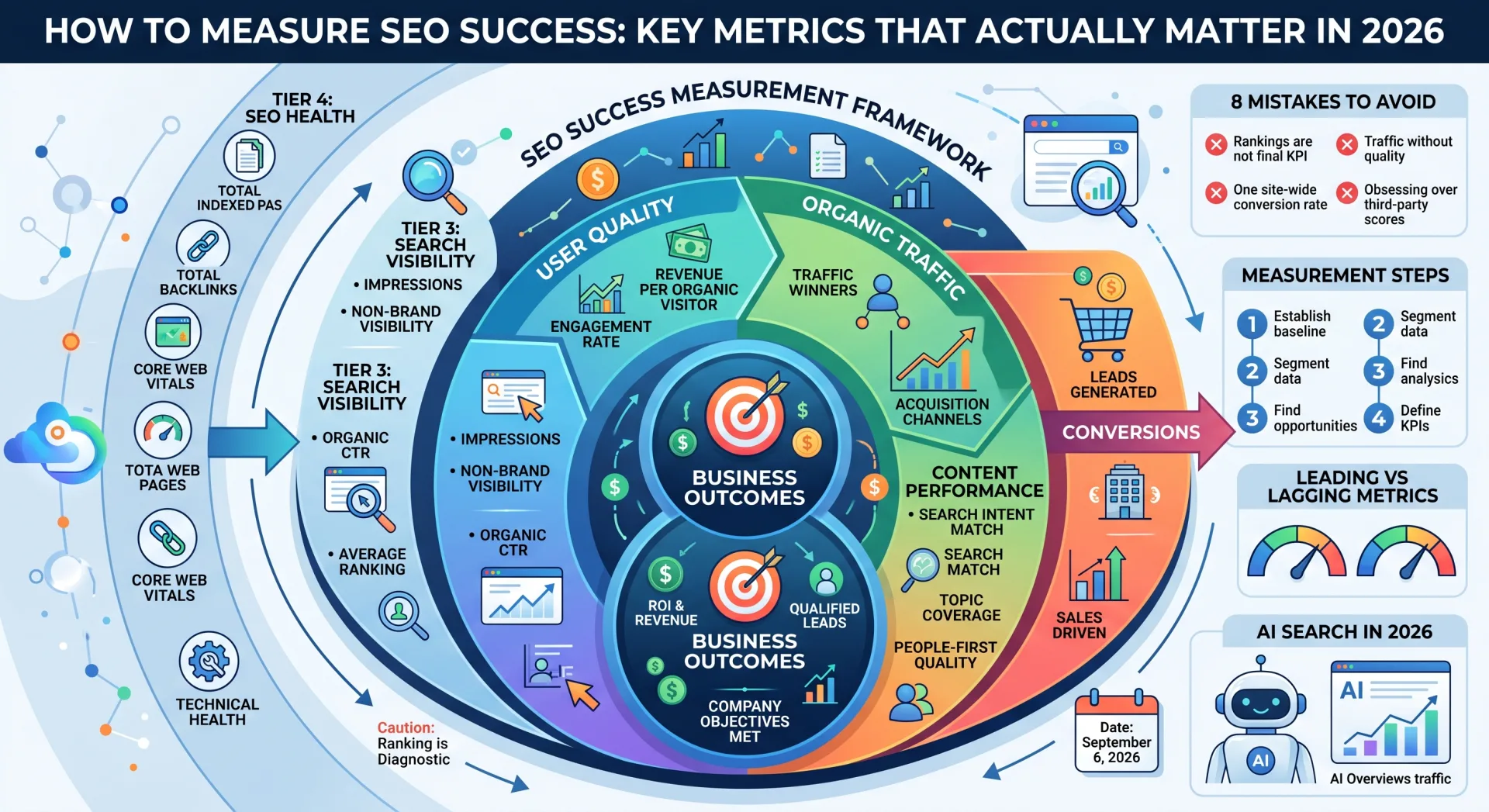
SEO success = better visibility + qualified organic traffic + meaningful user actions + measurable business results.
This guide explains which SEO metrics actually matter in 2026, which metrics should be treated as supporting signals rather than goals, how to measure them with Google Search Console and Google Analytics, and how to build an SEO reporting system that connects rankings to real outcomes.
What Does SEO Success Actually Mean?
SEO success means achieving the outcomes that organic search is supposed to produce for a particular website.
Those outcomes are different depending on the business.

For example:
-
An ecommerce store may care primarily about organic revenue and purchases.
-
A B2B company may care about qualified leads and pipeline.
-
A publisher may care about engaged organic users, returning visitors, and subscriptions.
-
A SaaS company may care about trial registrations, qualified accounts, and customer acquisition.
-
A local business may care about calls, directions, bookings, and inquiries.
-
An informational website may care about qualified traffic, newsletter registrations, or returning audiences.
Therefore, there is no universal SEO metric that determines whether a campaign is successful.
The important question is not:
"Did our rankings improve?"
It is:
"Did organic search become more valuable to the business?"
Google's own guidance emphasizes creating helpful, reliable, people-first content rather than content designed primarily to manipulate search rankings.
That principle also provides a useful foundation for SEO measurement: measure whether search visibility is producing useful experiences and meaningful outcomes, not simply whether a number in an SEO platform increased.
The SEO Metrics That Matter Most in 2026
A useful SEO measurement system should generally include five layers:
| Measurement layer | Important metrics |
|---|---|
| Search visibility | Impressions, ranking distribution, query visibility |
| Search traffic | Organic clicks, organic users, landing-page traffic |
| Traffic quality | Engagement, engaged sessions, user behavior |
| Business outcomes | Leads, purchases, revenue, key events |
| SEO health | Indexing, crawlability, Core Web Vitals, technical issues |
There is also a sixth category that is becoming increasingly important:
Search opportunity and resilience.
This includes measuring how dependent your website is on a small number of queries, pages, or traffic sources and whether your organic visibility is becoming broader and more durable.
The metrics below should therefore not be treated as isolated numbers.
They form a measurement system.
1. Organic Search Clicks
Organic clicks are one of the most fundamental SEO metrics.
In Google Search Console, clicks represent visits to your website from Google's organic search results. Google also makes Search Console clicks available through its Google organic search traffic reporting when the services are connected.
Why organic clicks matter
Clicks tell you whether search visibility is translating into actual visits.
If impressions increase but clicks remain flat, your website is becoming more visible without necessarily attracting more searchers.
If clicks increase, that usually indicates that more people are selecting your pages from search results.
But clicks should not be interpreted alone.
Consider two situations:
Scenario A
-
100,000 organic clicks
-
Very low conversion rate
-
Poor commercial relevance
Scenario B
-
20,000 organic clicks
-
Highly qualified visitors
-
Strong lead generation
-
Significant revenue
Scenario B may represent the much stronger SEO program.
So organic clicks are an important traffic metric , but they are not necessarily the ultimate measure of SEO success.
What to analyze
Do not only monitor total clicks.
Break them down by:
-
Landing page
-
Search query
-
Country
-
Device
-
Search appearance
-
Brand vs. non-brand searches
-
Topic or content cluster
-
New vs. existing pages
-
Commercial vs. informational intent
This reveals where growth is actually coming from.
2. Organic Impressions
An impression occurs when your site appears in Google's search results.
Impressions measure search visibility , not traffic.
Google Search Console reports impressions alongside clicks, CTR, and average position.
Why impressions matter
Impressions can reveal opportunities that clicks alone hide.
Suppose a page has:
-
50,000 impressions
-
1,000 clicks
The page is receiving substantial visibility, but only a relatively small portion of users are clicking.
That could indicate opportunities involving:
-
Search intent alignment
-
Title optimization
-
SERP competition
-
Search-result features
-
Brand recognition
-
Query targeting
-
Content relevance
On the other hand, a page with only 200 impressions cannot generate significant organic traffic regardless of how good its CTR is.
The important distinction
Think of impressions as:
"How often are we being considered?"
and clicks as:
"How often are searchers choosing us?"
Both are useful, but they answer different questions.
3. Organic Click-Through Rate (CTR)
Organic CTR measures the percentage of impressions that result in clicks.
The basic formula is:
CTR = Clicks ÷ Impressions × 100
For example:
-
10,000 impressions
-
500 clicks
CTR:
500 ÷ 10,000 × 100 = 5%
Google defines organic search CTR as clicks per impression in its Search Console reporting.
Why CTR matters
CTR helps diagnose the relationship between visibility and selection.
A page may rank reasonably well but receive fewer clicks than expected because its search result is less compelling or less aligned with user intent.
However, there is an important mistake to avoid:
Do not use one universal CTR benchmark.
CTR varies dramatically depending on:
-
Position
-
Query intent
-
Brand recognition
-
Device
-
Country
-
SERP features
-
Query type
-
Search behavior
-
Industry
A branded query can have a very different CTR from a generic informational query.
Therefore, CTR is more useful when compared against:
-
The same page over time
-
Similar query groups
-
Similar search intents
-
The same device
-
The same country
-
Comparable pages
CTR is diagnostic, not the final goal
Increasing CTR is useful only if the resulting traffic is valuable.
A misleading title can theoretically increase clicks while making users less satisfied.
That is not sustainable SEO.
4. Average Position and Ranking Distribution
Average position is one of the most commonly reported SEO metrics.
Google describes average position as the average ranking position of your URLs for reported queries.
It is useful, but it is often misunderstood.
Why average position can be misleading
Suppose a site ranks:
-
#1 for one query
-
#20 for another
-
#50 for another
The average position does not necessarily describe the actual visibility of the website in a meaningful way.
A better approach is to examine ranking distribution .
For example:
| Ranking range | Interpretation |
|---|---|
| Positions 1–3 | Strong visibility |
| Positions 4–10 | High-value optimization opportunities |
| Positions 11–20 | Pages with potential to enter stronger visibility |
| Positions 21–50 | Emerging or weaker visibility |
| 50+ | Limited practical visibility |
These ranges are analytical groupings rather than universal Google thresholds.
The most useful ranking question
Instead of asking:
"What's our average ranking?"
ask:
"How many valuable queries and pages are moving into stronger visibility ranges?"
That gives you a much more actionable picture.
5. Non-Brand Organic Visibility
One of the most important SEO distinctions is between branded and non-branded search.
Suppose your company is called ExampleTech.
Ranking #1 for:
ExampleTech
is valuable, but it does not necessarily demonstrate that your SEO strategy is reaching people who were previously unaware of your brand.
Non-brand searches might include:
-
best project management software
-
technical SEO tools
-
how to optimize website speed
-
SEO reporting software
These searches demonstrate visibility for broader topics.
Why non-brand visibility matters
If your objective is to acquire new audiences, non-brand organic performance can be much more informative than total organic traffic.
A website might report:
+40% organic traffic
while most of the increase comes from people already searching for its brand.
That is very different from:
+40% non-brand organic traffic
generated from relevant category and problem-based searches.
For many SEO programs, non-brand growth should therefore be a core KPI.
6. Organic Traffic
Organic traffic measures users or sessions originating from organic search.
Google Analytics provides traffic-source dimensions that allow marketers to analyze where users originate and how those users behave.
Organic traffic remains important.
But "more organic traffic" should never automatically equal "better SEO."
Why traffic alone is insufficient

Imagine an SEO campaign increases traffic by 100%.
If:
-
Leads decrease
-
Sales decrease
-
Engagement deteriorates
-
The traffic comes from irrelevant queries
then SEO performance may actually have worsened.
Traffic should therefore be evaluated according to quality and outcome .
A useful framework is:
Organic traffic → engagement → key action → business value
7. Organic Landing Pages
A major improvement over looking only at total organic traffic is analyzing which pages receive that traffic .
For each important landing page, examine:
-
Organic clicks
-
Organic users
-
Impressions
-
CTR
-
Ranking distribution
-
Engagement
-
Key events
-
Revenue or lead value
-
New vs. returning users
-
Search intent
This allows you to identify your actual SEO winners.
For example:
| Page | Organic users | Key events | Revenue |
|---|---|---|---|
| Page A | 30,000 | 120 | $2,000 |
| Page B | 12,000 | 850 | $18,000 |
| Page C | 7,000 | 1,100 | $25,000 |
Page A gets the most traffic.
But Pages B and C are considerably more valuable.
This is why SEO reporting should move from traffic volume toward traffic value .
8. Engagement and Engaged Sessions
Traffic tells you that people arrived.
Engagement helps you understand what happened afterward.
Google Analytics provides engagement-related metrics and traffic acquisition reports that can be segmented by traffic source.
Important questions include:
-
Did users meaningfully interact with the page?
-
Did they visit additional pages?
-
Did they complete important events?
-
Did they engage with the content?
-
Did they return later?
Be careful with bounce rate
Bounce rate can be useful diagnostically, but it should not automatically be treated as an SEO quality score.
For example, someone searching:
"What is the HTTP 404 status code?"
might visit a page, find the exact answer immediately, and leave.
That could be a successful user experience even though the session is short.
A user searching:
"Best CRM for a 50-person sales team"
may need multiple pages before making a decision.
The correct interpretation depends on intent.
9. Key Events and Conversions
This is where SEO measurement becomes much more meaningful.
A key event is an important user action that you want to measure in Analytics.
A conversion is built from an Analytics event and can be used for consistent measurement across Analytics and Google Ads.
Examples include:
-
Form submission
-
Product purchase
-
Trial registration
-
Newsletter signup
-
Demo request
-
Phone call
-
Account creation
-
Booking
-
Download
-
Contact request
For SEO, these metrics often matter more than rankings.
Example
Suppose organic search produces:
100,000 visitors
and:
500 leads
The conversion rate is:
0.5%
If optimization increases organic traffic to 120,000 but leads remain at 500, traffic increased by 20% while lead generation did not.
Now suppose traffic reaches only 105,000 but leads increase to 750.
The second scenario may represent a much more successful SEO strategy.
10. Organic Conversion Rate
Organic conversion rate measures the percentage of organic users or sessions that complete a defined conversion or key action.
A simple formula is:
Organic conversion rate = Organic conversions ÷ Organic users or sessions × 100
The denominator should be chosen consistently for the reporting model.
For example:
-
20,000 organic sessions
-
400 leads
Conversion rate:
400 ÷ 20,000 × 100 = 2%
The exact metric definition should remain consistent when comparing periods.
Why this metric matters
It helps answer:
"Is SEO attracting people who are likely to take valuable actions?"
A high-converting page with modest traffic can be more valuable than a high-traffic informational page.
This is especially important for:
-
B2B companies
-
SaaS businesses
-
Ecommerce
-
Professional services
-
Local businesses
11. Organic Revenue
For ecommerce and other monetized websites, organic revenue is one of the strongest SEO business metrics.
Instead of asking:
"How much traffic did SEO generate?"
ask:
"How much measurable revenue was associated with organic search?"
Google Analytics supports revenue measurement and can connect organic traffic with important user actions and business outcomes.
Useful measurements include:
-
Organic revenue
-
Organic purchases
-
Revenue per organic user
-
Revenue per landing page
-
Revenue by content category
-
Revenue by product category
-
Organic-assisted conversions
-
New-customer revenue from organic search
Revenue per organic visitor
A useful derived metric is:
Organic revenue per visitor = Organic revenue ÷ Organic visitors

This can help distinguish between traffic growth and valuable traffic growth.
12. Lead Quality, Not Just Lead Quantity
For lead-generation websites, counting leads is not enough.
Imagine two SEO campaigns:
Campaign A
-
1,000 leads
-
10 qualified opportunities
Campaign B
-
400 leads
-
80 qualified opportunities
Campaign B may be dramatically more valuable.
Therefore, advanced SEO reporting should connect organic acquisition to downstream CRM outcomes when possible.
Useful metrics include:
-
Marketing-qualified leads
-
Sales-qualified leads
-
Qualified opportunities
-
Pipeline generated
-
Closed deals
-
Customer acquisition value
This transforms SEO reporting from:
"Marketing traffic reporting"
into:
"Business performance reporting."
13. Cost per Organic Acquisition
SEO is often described as "free traffic."
That description is misleading.
SEO requires investment in:
-
Content
-
Developers
-
Technical optimization
-
SEO tools
-
Research
-
Digital PR
-
Link acquisition
-
Editors
-
Analysts
-
Strategy
-
Maintenance
A useful business metric is therefore:
Organic acquisition cost = SEO investment ÷ acquired customers
This can be compared with paid acquisition channels.
However, SEO has a different cost structure from paid advertising, so comparisons should account for time horizon and attribution.
A new SEO page may require months of investment before generating meaningful returns.
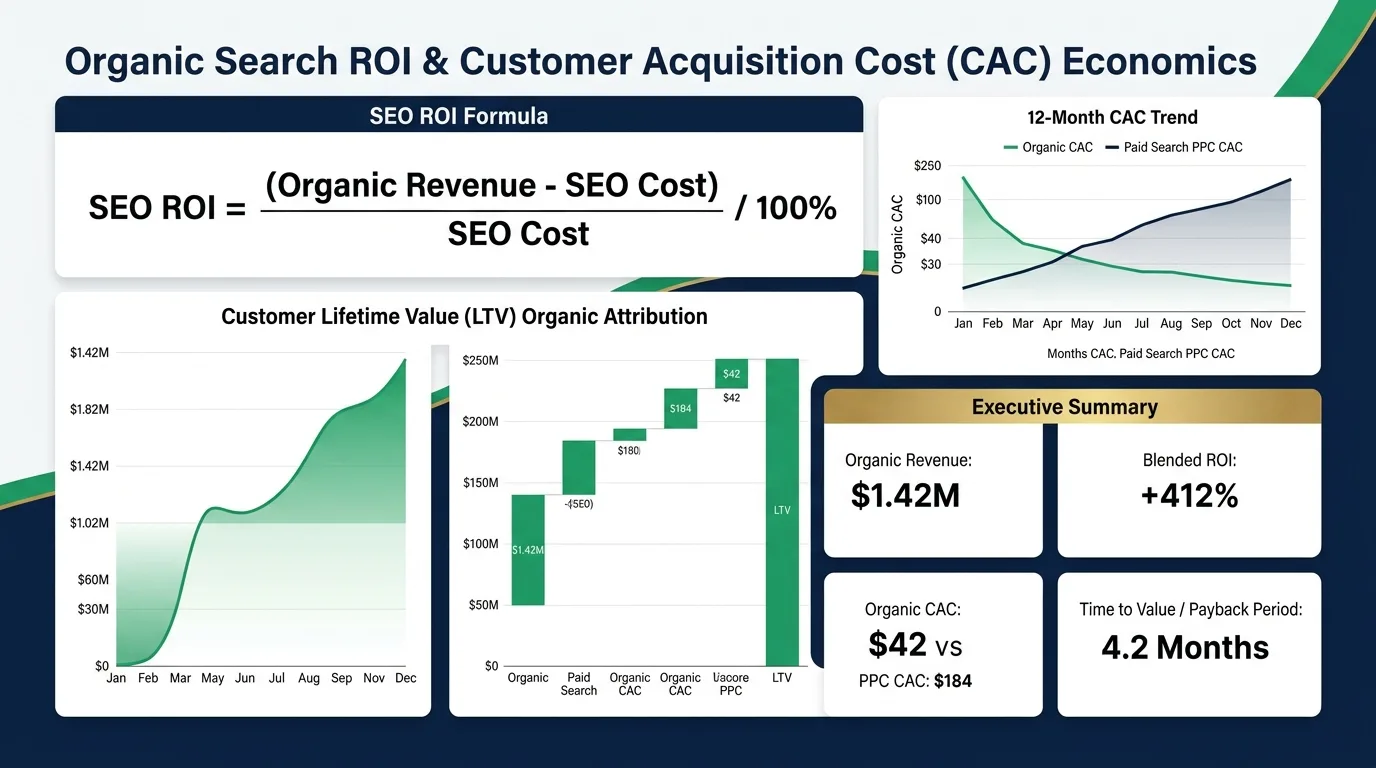
14. Return on SEO Investment
A simplified ROI calculation is:
SEO ROI = (SEO-attributed value − SEO cost) ÷ SEO cost × 100
For example:
-
SEO investment: $20,000
-
Attributed gross profit/value: $60,000
ROI:
($60,000 − $20,000) ÷ $20,000 × 100 = 200%
But attribution is rarely perfect.
Organic search may contribute to a customer's journey without being the only channel responsible for the purchase.
Google Analytics provides attribution features designed to help marketers understand how different channels contribute to important actions.
Therefore, treat SEO ROI as a measurement model rather than an absolute truth.
15. Search Visibility Across Topics
SEO success is not just about individual keywords.
A strong site should develop visibility across a relevant topic ecosystem .
For example, an SEO website might target a broader topic such as technical SEO.
Its visibility could include:
-
Technical comprehensive SEO audit
-
Technical SEO checklist
-
Crawl budget
-
Canonical tags
-
XML sitemaps
-
Robots.txt
-
Indexing problems
-
JavaScript SEO
-
Core Web Vitals
Instead of measuring only one keyword, measure the site's visibility across the topic.
This is particularly useful because modern search systems evaluate content using many signals and systems rather than a simplistic one-keyword model. Google's ranking systems have also evolved so that the former Helpful Content System became part of its core ranking systems in 2024.
16. Number of Ranking Keywords
SEO platforms commonly provide the number of keywords for which a domain ranks.
This can be useful as a diagnostic metric.
But it should not be treated as a primary KPI.
Ranking for thousands of irrelevant, low-value queries does not necessarily represent SEO success.
A better measurement is:
Relevant ranking keywords × search visibility × business value
A site ranking for 500 highly relevant commercial queries can be stronger than a site ranking for 50,000 irrelevant queries.
17. Indexed Pages and Index Coverage
Search engines cannot rank pages effectively if the intended pages are not properly discoverable and indexable.
Therefore, SEO reporting should include technical visibility indicators such as:
-
Indexed pages
-
Non-indexed pages
-
Unexpected exclusions
-
Crawl errors
-
Sitemap status
-
Canonicalization issues
-
Important pages blocked from crawling
-
Pages discovered but not properly indexed
These are generally health metrics , not business KPIs.
That distinction matters.
You do not want a dashboard that celebrates "10,000 indexed pages" when only 500 of those pages are useful.
18. Core Web Vitals
Technical performance still matters, particularly because user experience is part of Google's broader page-experience guidance.
Google's current Core Web Vitals include:
-
LCP — Largest Contentful Paint: loading performance
-
INP — Interaction to Next Paint: responsiveness
-
CLS — Cumulative Layout Shift: visual stability
Google recommends:
-
LCP within 2.5 seconds
-
INP below 200 milliseconds
-
CLS at 0.1 or lower
for a good user experience.
However, Core Web Vitals should not be treated as a standalone ranking KPI.
Google explicitly recommends looking at page experience holistically rather than focusing on one or two metrics.
The right question is:
"Are technical problems preventing users and search engines from accessing and using our content effectively?"
19. Backlinks and Referring Domains
Links remain useful SEO signals and, more importantly, can contribute to authority, discovery, referral traffic, and reputation.
But raw backlink counts can be misleading.
For example:
Website A
-
50,000 backlinks
-
Mostly low-quality or repetitive sources
Website B
-
300 relevant links
-
Strong industry publications
-
Genuine editorial references
Website B may have a much healthier link profile.
Therefore, track:
-
Relevant referring domains
-
Quality of referring websites
-
Links to important pages
-
New links
-
Lost links
-
Relevant referral traffic
-
Links earned through original research or useful resources
Do not make "number of backlinks" the primary objective.
20. Brand Search Demand
SEO can influence more than direct organic clicks.
When people repeatedly encounter a brand through content, search, social media, recommendations, or other channels, they may later search specifically for that brand.
Monitoring branded search demand can therefore provide useful context.
For example:
Before content campaign
"ExampleTool" searches: relatively low
After sustained visibility
"ExampleTool" searches: substantially higher
This does not prove that SEO alone caused the increase.
Brand demand is influenced by many channels.
But it can be a valuable supporting signal when analyzed alongside other evidence.
Which SEO Metrics Should Be Primary KPIs?
Not every metric deserves equal importance.
A useful hierarchy looks like this:
Tier 1: Business outcomes
These should usually receive the highest priority.
-
Organic revenue
-
Qualified leads
-
Sales
-
Pipeline
-
Customer acquisition
-
High-value key events
Tier 2: Organic performance
These explain how SEO contributes to those outcomes.
-
Organic clicks
-
Organic users
-
Non-brand traffic
-
Organic conversion rate
-
Landing-page performance
Tier 3: Search visibility
These help explain why performance is changing.
-
Impressions
-
CTR
-
Ranking distribution
-
Search visibility
-
Query coverage
Tier 4: SEO health
These identify technical or structural problems.
-
Indexability
-
Crawl issues
-
Core Web Vitals
-
Canonicals
-
Sitemap problems
-
Structured data issues
-
Internal linking
Tier 5: Diagnostic metrics
These can be useful but should rarely become the main goal.
-
Total backlinks
-
Domain authority scores
-
Keyword counts
-
Average position
-
Word count
-
Number of published articles
Metrics That Are Often Overvalued
Some SEO metrics are useful but frequently misunderstood.
Average ranking
Useful for diagnosing search visibility.
Not a direct measure of business success.
Domain Authority or similar third-party scores
Useful for competitive analysis.
Not a Google metric and not a direct representation of how Google evaluates a website.
Total backlinks
Useful as a diagnostic.
Raw quantity says little about relevance or quality.
Total indexed pages
Useful for technical monitoring.
More indexed pages do not automatically mean better SEO.
Organic traffic
Very important, but incomplete without quality and business outcomes.
Bounce rate
Useful in context.
Not a universal measurement of content quality.
Word count
There is no universal ideal article length that guarantees ranking. Google's own guidance explicitly warns against writing to a particular word count simply because someone claims Google prefers it.
How to Measure SEO Success in Google Search Console
Google Search Console should be one of the primary tools in an SEO measurement system.
It provides direct search-performance data including:
-
Clicks
-
Impressions
-
CTR
-
Average position
-
Queries
-
Pages
-
Countries
-
Devices
-
Search appearances
Google also provides an organic-search report in Analytics that incorporates Search Console data.
Step 1: Establish a baseline
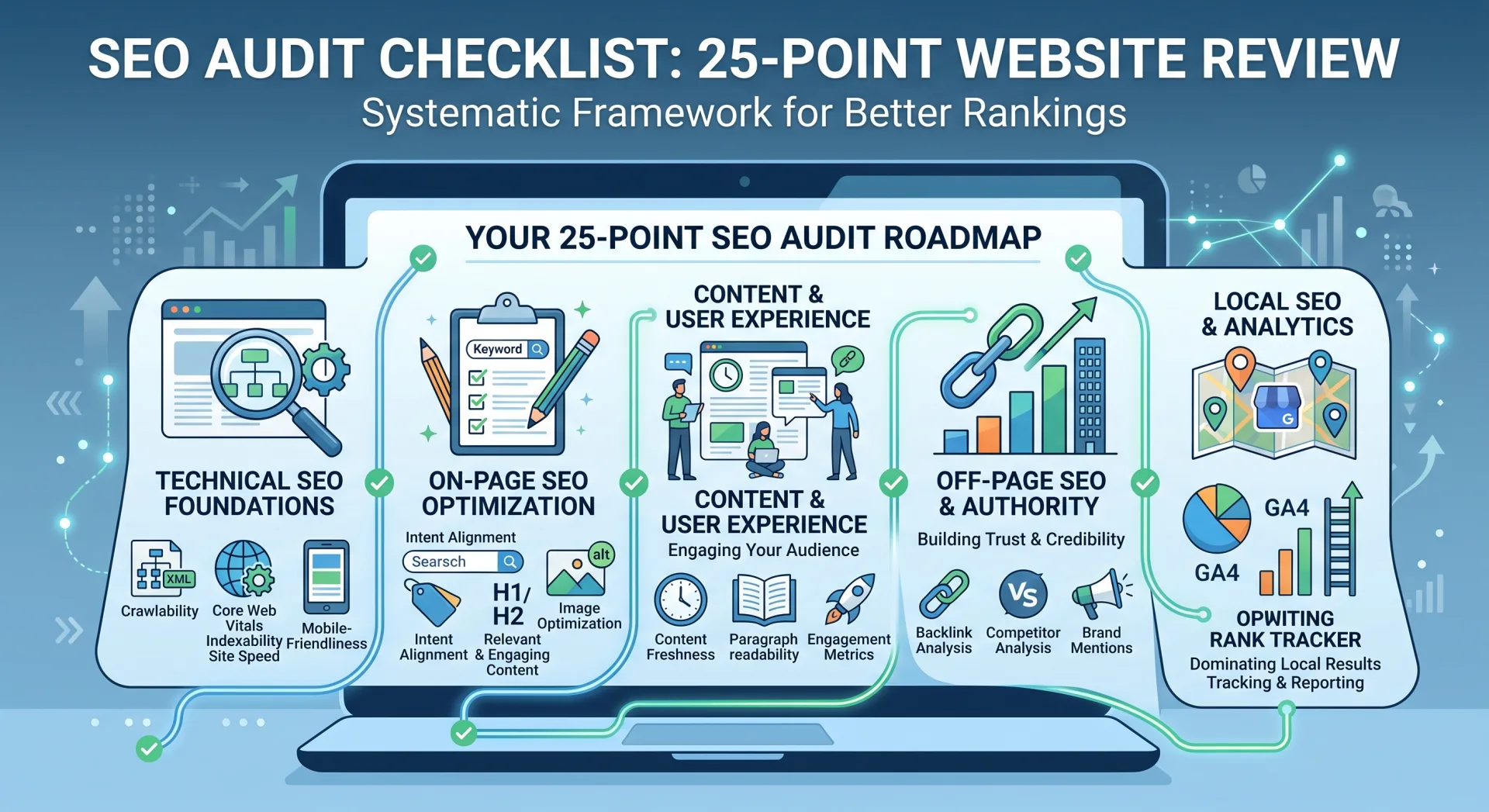
Before tracking incremental metric growth, audit your existing search foundations against our comprehensive 25-point SEO audit checklist.
Choose a meaningful comparison period.
Examples:
-
Month over month
-
Quarter over quarter
-
Year over year
Year-over-year comparisons are often especially useful for businesses affected by seasonality.
Record:
-
Organic clicks
-
Impressions
-
CTR
-
Average position
-
Non-brand performance
-
Top landing pages
-
Top queries
Step 2: Segment the data
Do not analyze the entire website as one number.
Segment by:
-
Page
-
Query
-
Country
-
Device
-
Search appearance
-
Brand/non-brand
-
Content type
-
Topic
-
Intent
Segmentation often reveals problems hidden by aggregate metrics.
Step 3: Find high-impression, low-CTR opportunities
Look for queries or pages that have:
-
Strong impressions
-
Reasonable visibility
-
Weak CTR
These may represent opportunities for:
-
Better titles
-
Better descriptions
-
Better intent alignment
-
Improved content
-
Better SERP positioning
Do not change titles solely to increase CTR if the current result accurately satisfies the query.

Step 4: Find positions with growth potential
Identifying striking-distance keywords requires systematic search intent classification. Review our tutorial on conducting modern keyword research.
Identify pages ranking in ranges where relatively small improvements could create meaningful additional visibility.
For example:
-
Page ranking around positions 8–15
-
Page receiving many impressions
-
Strong relevance
-
Good conversion potential
These pages can be high-priority optimization candidates.
How to Measure SEO Success in Google Analytics
Google Analytics answers a different question.
Search Console primarily helps answer:
"How are we performing in Google Search?"
Analytics helps answer:
"What happens after people arrive?"
Google's Search Console integration allows search-related data to be analyzed alongside user behavior and key events in Analytics.
Monitor organic traffic
Analyze:
-
Organic users
-
Organic sessions
-
Landing pages
-
Engagement
-
Key events
-
Revenue
Analyze acquisition
The GA4 Traffic Acquisition report allows you to understand where users come from and how different acquisition sources perform.
Connect traffic to outcomes

Google Analytics 4 blends referral sessions originating from generative engines (ChatGPT, Claude, Perplexity) into organic or referral channels. Build custom channel groupings in GA4 with regex on session_source (e.g., .*(openai|chatgpt|perplexity|claude|gemini).*) to isolate and measure your brand's AI search conversion velocity.

For example:
Organic Search → Landing Page → Engaged Session → Lead → Customer
This is much more informative than:
Organic Search → 10,000 visits
How to Build an SEO Measurement Framework
A strong SEO reporting system starts with business objectives.
Use this framework.
Step 1: Define the business objective
Examples:
-
Increase ecommerce revenue
-
Generate qualified B2B leads
-
Increase software trials
-
Grow subscriptions
-
Increase bookings
Step 2: Define the SEO objective
For example:
Increase qualified non-brand organic traffic to high-intent product pages.
Step 3: Define primary KPIs
For example:
-
Organic revenue
-
Qualified leads
-
Organic conversion rate
Step 4: Define supporting metrics
For example:
-
Organic clicks
-
Impressions
-
CTR
-
Ranking distribution
-
Landing-page traffic
Step 5: Define diagnostic metrics
For example:
-
Indexing
-
Core Web Vitals
-
Internal links
-
Referring domains
-
Crawl issues
This creates a hierarchy instead of a random dashboard.
A Practical SEO KPI Framework by Business Type
| Business | Primary SEO KPIs | Supporting metrics |
|---|---|---|
| Ecommerce | Organic revenue, purchases, revenue/user | Traffic, rankings, CTR |
| B2B SaaS | Qualified leads, pipeline, trials | Organic users, key events |
| Local business | Calls, bookings, inquiries | Local visibility, organic traffic |
| Publisher | Engaged users, subscriptions | Traffic, returning users |
| Affiliate site | Qualified clicks, affiliate revenue | Rankings, traffic, CTR |
| Lead generation | Qualified leads, opportunities | Organic sessions, conversion rate |
| Informational site | Engaged users, subscriptions, returning users | Impressions, clicks, topic visibility |
The correct KPI depends on what the website is actually trying to accomplish.
How to Measure SEO Performance at the Page Level
Page-level analysis is one of the most actionable approaches to SEO measurement.
For each important URL, track:
-
Search impressions
-
Search clicks
-
CTR
-
Ranking distribution
-
Organic users
-
Engagement
-
Key events
-
Revenue or lead value
-
Internal links
-
Referring domains
-
Technical health
Then classify pages.
SEO winners
High traffic + high business value.
Traffic winners
High traffic + low business value.
Conversion winners
Low/moderate traffic + high conversion rate.
Visibility opportunities
High impressions + weak clicks.
Underperformers
Low visibility + low business value.
This classification helps determine where SEO resources should go.
How to Measure Content SEO Success
Content should not be evaluated simply by how many articles are published.
A better content measurement model is:
Content published → indexed → visible → clicked → engaged → converts → generates value
For each content cluster, evaluate:
-
Organic visibility
-
Organic clicks
-
Non-brand traffic
-
Engagement
-
Internal link contribution
-
Assisted conversions
-
Direct conversions
-
Revenue contribution
-
Backlinks and references
-
Updating requirements
Google's people-first guidance emphasizes content that is original, useful, complete, trustworthy, and created primarily to help people.
Therefore, content success should ultimately reflect whether content solves meaningful user problems.
How to Measure Technical SEO Success
Technical SEO is often misunderstood because its success may appear as the absence of problems.
Useful technical metrics include:
-
Important pages indexed
-
Crawl errors reduced
-
Canonical problems resolved
-
Sitemap errors reduced
-
Mobile usability improved
-
Core Web Vitals improved
-
Page performance improved
-
Internal linking improved
-
Structured data errors resolved
The goal is not to achieve a perfect technical score.
The goal is to remove technical barriers that interfere with:
-
Discovery
-
Crawling
-
Indexing
-
Rendering
-
Understanding
-
User experience
Google's Search Essentials emphasizes that relatively few technical requirements are necessary for a page to be eligible for search, while people-first content remains a central principle.
SEO Measurement in the Era of AI Search
SEO measurement in 2026 cannot ignore AI-powered search experiences.
Search behavior is evolving beyond the traditional ten-blue-links model.
Google Analytics currently classifies organic search as including non-ad links from search experiences such as Google AI Overviews and AI Mode.
This creates an important measurement principle:
Do not assume that every change in search behavior will appear as a simple ranking change.
A page can have:
-
Traditional search visibility
-
Visibility in richer search features
-
Brand exposure
-
Organic clicks
-
Assisted conversions
These should be evaluated together.
What should you measure?
Where data is available, monitor:
-
Organic traffic trends
-
Search impressions
-
Clicks
-
Query visibility
-
Search appearance
-
Landing-page performance
-
Brand search demand
-
Conversions from organic traffic
-
Revenue and qualified leads
Do not create an artificial "AI SEO score" unless it corresponds to a measurable business or search outcome.
The objective remains the same:
Be visible where relevant users search and generate meaningful value when they find you.
A Better Way to Think About Rankings in 2026
Rankings still matter.
But rankings are best understood as an intermediate outcome .
The chain looks like this:
SEO work
↓
Search visibility
↓
Rankings / search appearances
↓
Impressions
↓
Clicks
↓
Engagement
↓
Key events
↓
Revenue / leads / customers
If you only measure the ranking layer, you are measuring one part of the system.
For example:
A keyword moves from position 12 to position 5.
That sounds positive.
But if:
-
Impressions remain insignificant
-
Search intent is wrong
-
CTR is poor
-
Visitors do not convert
the business impact may be negligible.
Conversely, a group of lower-volume keywords might generate highly qualified customers.
That is why SEO reporting should follow the complete funnel.
Common SEO Measurement Mistakes
A website can celebrate a 200% increase in total impressions while revenue remains completely flat. In 2026, ranking #1 for zero-intent informational queries that are entirely answered by Google AI Overviews creates an illusion of performance. Always connect organic visibility to assisted conversions, lead qualification, and customer lifetime value (LTV).
Mistake 1: Treating rankings as the final KPI
Rankings are important but are not the business outcome.
Better approach
Connect rankings to clicks, conversions, and revenue.
Mistake 2: Celebrating traffic without checking quality
More traffic can be meaningless if visitors are irrelevant.
Better approach
Measure engagement and business outcomes by landing page and query intent.
Mistake 3: Using one site-wide conversion rate
Different pages have different purposes.
Better approach
Segment by:
-
Landing page
-
Search intent
-
Content type
-
Product
-
Device
-
Country
Mistake 4: Optimizing for CTR at any cost
Clickbait can increase clicks while reducing satisfaction.
Better approach
Optimize titles and snippets for accurate relevance.
Mistake 5: Obsessing over third-party authority scores
Third-party SEO scores can be useful for competitive research but should not replace actual performance data.
Better approach
Use them diagnostically and prioritize first-party outcomes.
Mistake 6: Reporting only monthly totals
Monthly totals hide important changes.
Better approach
Compare:
-
Year over year
-
Page by page
-
Query by query
-
Brand vs. non-brand
-
Device
-
Country
-
Content cluster
Mistake 7: Ignoring seasonality
A traffic decline does not necessarily mean SEO failed.
Search demand may naturally change.
Better approach
Use year-over-year comparisons and compare against search-demand patterns where possible.
Mistake 8: Measuring everything
A dashboard with 70 metrics does not necessarily provide better insight.
Better approach
Choose a small number of primary KPIs and use supporting metrics for diagnosis.
How Often Should You Measure SEO?
Different metrics require different reporting frequencies.
| Frequency | What to monitor |
|---|---|
| Daily | Major technical problems, unusual traffic changes |
| Weekly | Traffic trends, indexing, major ranking changes |
| Monthly | SEO KPIs, landing pages, conversions |
| Quarterly | Strategy, content clusters, ROI |
| Yearly | Business impact, organic growth, strategic direction |
Do not overreact to daily fluctuations.
SEO often involves delays between implementation and measurable results.
The longer the time horizon, the more useful the analysis generally becomes.
A Simple SEO Dashboard for 2026
If you want a practical dashboard without unnecessary complexity, start with these metrics.
Business outcomes
-
Organic revenue
-
Qualified organic leads
-
Organic conversions
-
Organic pipeline
Search performance
-
Organic clicks
-
Organic impressions
-
CTR
-
Non-brand clicks
-
Ranking distribution
User quality
-
Organic engaged sessions
-
Key events
-
Organic conversion rate
-
Revenue per organic user
Technical health
Technical health forms the baseline of organic ranking potential. Dive into our complete engineering guide on Core Web Vitals optimization in 2026.

-
Indexing issues
-
Core Web Vitals
-
Crawl problems
-
Important page errors
Content performance
-
Top organic landing pages
-
Content clusters
-
Pages gaining visibility
-
Pages losing visibility
-
Content with high traffic but low conversion
That is enough for most businesses to create a useful SEO performance system.
The Most Important SEO Metrics by Question
A useful way to select metrics is to start with the question you need to answer.
| Question | Metrics |
|---|---|
| Are we becoming more visible? | Impressions, ranking distribution |
| Are people clicking us? | Clicks, CTR |
| Are we attracting new audiences? | Non-brand clicks/users |
| Are visitors valuable? | Engagement, key events |
| Are we generating leads? | Organic conversions, qualified leads |
| Are we making money? | Organic revenue, pipeline |
| Which pages work? | Landing-page performance |
| Which content needs improvement? | Visibility + traffic + conversion |
| Is technical SEO healthy? | Indexing, crawl issues, Core Web Vitals |
| Is SEO becoming more resilient? | Topic coverage, page distribution, non-brand visibility |
This approach is much more useful than simply creating a list of every metric available in an SEO platform.
How to Create an SEO Scorecard
A simple scorecard can contain four levels.
Level 1: Business
Primary KPI: Organic revenue
Level 2: Acquisition
Primary KPI: Qualified organic traffic
Level 3: Search
Primary KPIs: Clicks, impressions, non-brand visibility
Level 4: Health
Primary KPIs: Indexability, technical issues, Core Web Vitals
Then ask every month:
-
What improved?
-
What declined?
-
Why?
-
Which pages caused the change?
-
Which queries caused the change?
-
Did the change affect business outcomes?
-
What should we do next?
The last question is critical.
A dashboard should lead to decisions.
A Practical Monthly SEO Analysis Process
Use this process every month.
Step 1: Check business outcomes
Start with:
-
Revenue
-
Leads
-
Customers
-
Pipeline
Do not start with rankings.
Step 2: Check organic acquisition
Review:
-
Organic users
-
Organic sessions
-
Non-brand traffic
-
Landing pages
Step 3: Check Search Console
Review:
-
Clicks
-
Impressions
-
CTR
-
Position
-
Queries
-
Pages
Step 4: Identify winners
Find pages and queries with meaningful growth.
Step 5: Identify losers
Find pages experiencing significant declines.
Step 6: Diagnose the cause
If your metric drop is precipitous rather than gradual, your domain may have been affected by a broad core update or manual action. Follow our forensic playbook on how to recover from a Google penalty.

Possible explanations include:
-
Algorithm changes
-
Seasonality
-
Search-demand changes
-
Technical problems
-
Content decay
-
Increased competition
-
SERP changes
-
Internal cannibalization
-
Changes in user behavior
Step 7: Prioritize actions
Do not create a huge task list.
Choose the improvements most likely to affect meaningful outcomes.
The Difference Between Leading and Lagging SEO Metrics
This distinction can improve SEO reporting significantly.

Leading metrics
These indicate that progress may be developing.
Examples:
-
New relevant pages indexed
-
Improved technical health
-
New high-quality referring domains
-
Increased impressions
-
More keywords entering stronger ranking ranges
-
Improved content coverage
Lagging metrics
These show realized outcomes.
Examples:
-
Leads
-
Sales
-
Revenue
-
Customers
-
Pipeline
Both matter.
Leading metrics help explain where performance may be heading.
Lagging metrics tell you whether the strategy actually produced results.
What Does "Good SEO Performance" Look Like?
There is no universal benchmark.
A healthy SEO program generally demonstrates some combination of:
-
Increasing relevant search visibility
-
Increasing qualified organic traffic
-
Growing non-brand discovery
-
Improving engagement where appropriate
-
Increasing valuable key events
-
Increasing organic revenue or qualified leads
-
Stable or improving technical health
-
Expanding visibility across relevant topics
-
Reduced dependence on a small number of pages or queries
The exact numbers depend on the business.
A 10% increase may be excellent for one company and disappointing for another.
Always compare performance against:
-
Historical performance
-
Business goals
-
Search demand
-
Competitors
-
Seasonality
-
Investment level
SEO Success Is a System, Not a Single Number
The biggest mistake in SEO measurement is searching for one metric that says:
"SEO is working."
There isn't one.
Instead, SEO should be measured as a connected system.
A useful model is:
Visibility → Traffic → Quality → Action → Business Value
For example:
Impressions
↓
Clicks
↓
Qualified organic users
↓
Engaged sessions
↓
Key events
↓
Qualified leads
↓
Customers
↓
Revenue
This model helps prevent misleading conclusions.
If impressions increase but clicks do not, investigate CTR and SERP positioning.
If clicks increase but engagement falls, investigate traffic quality and search intent.
If engagement increases but conversions do not, investigate the conversion path.
If conversions increase but revenue does not, investigate lead quality, product-market fit, pricing, or sales performance.
SEO measurement becomes powerful when the numbers tell you where the problem or opportunity exists .
Final Recommendations
If you are building an SEO measurement system in 2026, prioritize these metrics in roughly this order:
-
Organic revenue or qualified business outcomes
-
Organic conversions and key events
-
Qualified organic traffic
-
Non-brand organic performance
-
Organic clicks
-
Organic impressions
-
CTR
-
Ranking distribution
-
Landing-page performance
-
Technical SEO health
Use other metrics such as backlinks, third-party authority scores, keyword counts, and average position as supporting diagnostics rather than primary definitions of success.
Most importantly, do not optimize your SEO strategy around numbers simply because they are easy to report.
Optimize around outcomes.
The strongest SEO dashboard is not the one with the most metrics. It is the one that makes it obvious what is working, what is not working, why it is happening, and what you should do next.
FAQ: Measuring SEO Success
Frequently Asked Questions (FAQ)
What is the most important SEO metric?
There is no single metric that is most important for every website. For businesses, organic revenue, qualified leads, customers, or other meaningful business outcomes are usually more important than rankings or traffic alone.
Is organic traffic still an important SEO metric in 2026?
Yes. Organic traffic remains an important measurement of search acquisition, but it should be evaluated alongside traffic quality, engagement, conversions, and business outcomes.
Are Google rankings still important?
Yes. Rankings remain useful for understanding search visibility. However, ranking position is an intermediate SEO metric rather than a complete measure of business success.
Should I focus on impressions or clicks?
Both serve different purposes. Impressions measure visibility, while clicks measure how often users choose your result. If impressions rise but clicks do not, investigate CTR, search intent, SERP competition, and search-result presentation.
What is a good organic CTR?
There is no universal "good" CTR. CTR varies significantly by ranking position, query intent, device, brand recognition, country, and SERP features. Compare CTR against similar queries and your own historical performance rather than relying on one industry-wide number.
Is average position a reliable SEO KPI?
Average position is useful but imperfect. Ranking distribution and page/query-level analysis often provide more actionable information than a single site-wide average position.
Should SEO reporting include conversions?
Absolutely. Conversions are among the most important metrics because they show whether organic search is producing meaningful user actions.
Are backlinks still important for measuring SEO success?
Backlinks can be useful as a supporting SEO signal, but the number of backlinks should not be treated as the primary definition of SEO success. Relevance, quality, context, and the resulting business or search impact matter more than raw volume.
How should SEO be measured for content websites?
Measure content through the complete journey: visibility, clicks, qualified traffic, engagement, key events, subscriptions, revenue, and long-term audience value. Do not judge content success simply by traffic or the number of articles published.
How should SEO be measured for ecommerce websites?
Focus heavily on organic revenue, purchases, revenue per organic user, product-page performance, conversion rate, and non-brand visibility. Traffic and rankings should support these business metrics rather than replace them.
How should SEO be measured for a B2B website?
Measure qualified organic leads, sales-qualified opportunities, pipeline, and ultimately customers or revenue. Because B2B buying journeys can be long, connecting Analytics with CRM data can provide a much more accurate picture of SEO's business contribution.
Does AI search change how SEO should be measured?
Yes, search experiences are becoming more diverse. Google Analytics currently includes non-ad organic links from experiences such as AI Overviews and AI Mode within the Organic Search channel.
How often should I report SEO performance?
Weekly monitoring can help detect important changes, but monthly reporting is generally more useful for regular performance analysis. Quarterly reviews are useful for strategy, content, technical SEO, and ROI. Year-over-year comparisons are particularly useful when seasonality is significant.


Ratings & reviews
No reviews yet. Be the first.