
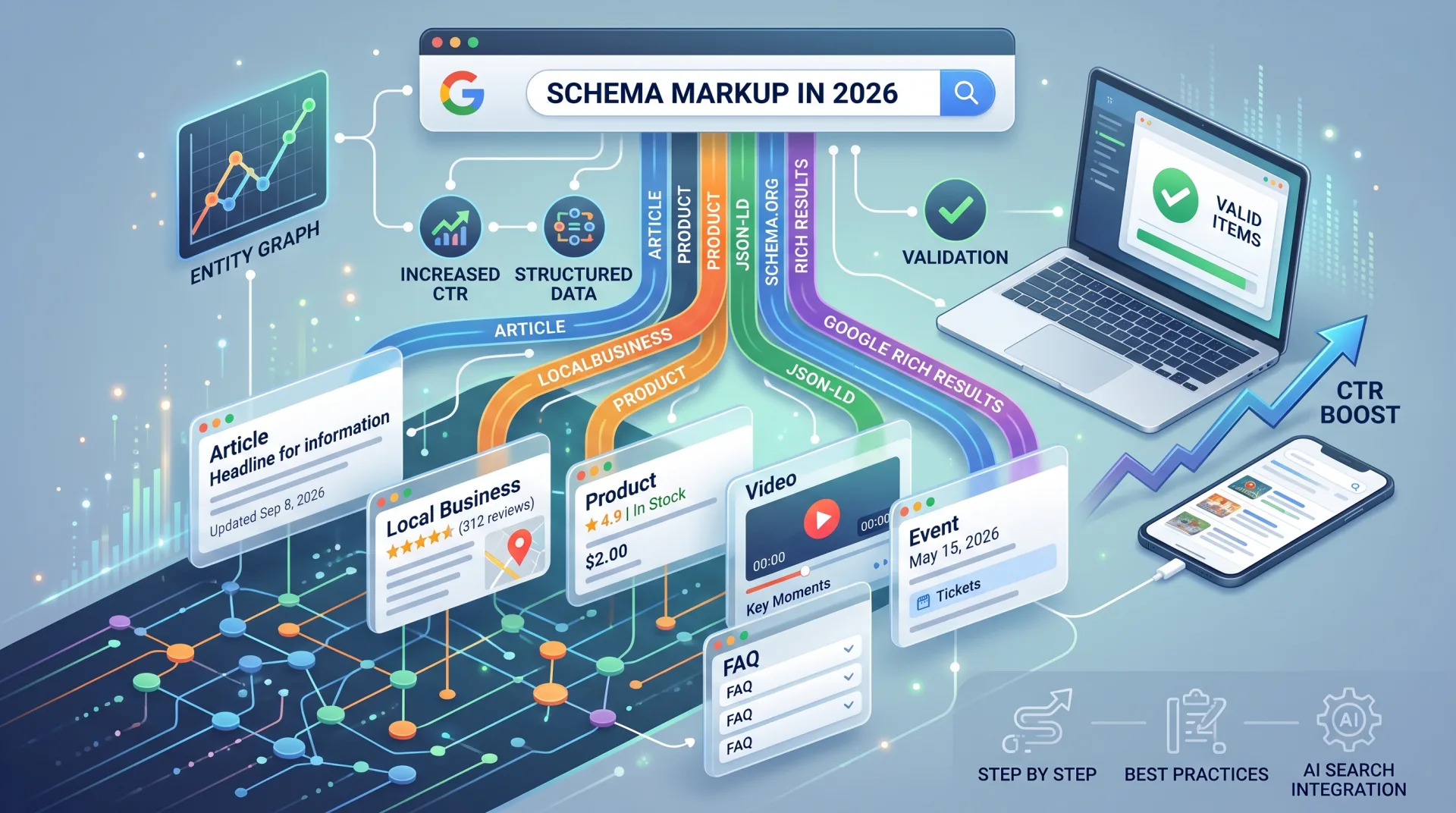
Schema markup is one of the most useful ways to give search engines clearer, machine-readable information about the content and entities on your website. But in 2026, effective structured data is no longer about adding as many schema types as possible or assuming that markup automatically produces rich snippets.
Modern schema SEO is about accurately describing what a page is, what entities it contains, and how those entities relate to one another. When the implementation follows Google's current requirements, structured data can make a page eligible for certain enhanced search appearances, which may improve how the result is presented and potentially increase its click-through rate (CTR).
This guide explains what schema markup is, how structured data works, which schema types matter in 2026, how to implement JSON-LD correctly, how to validate your markup, what has changed in Google's rich-result ecosystem, and how to measure whether your implementation is actually improving search performance.
What Is Schema Markup?

Schema markup is structured data that uses a standardized vocabulary to describe the content, entities, and relationships represented on a web page. The most widely used vocabulary is Schema.org.
For example, a human reader can understand that an article was written by a particular author and published on a specific date. Structured data allows you to express those relationships in a machine-readable format that search engines can process.
Schema markup helps search engines understand your content. It can make eligible pages qualify for enhanced search features, but valid schema does not guarantee that Google will display a rich result.
Schema Markup vs. Structured Data vs. Rich Results
These terms are often used interchangeably, but they describe different things.
| Term | Meaning |
|---|---|
| Schema.org | A standardized vocabulary for describing entities and relationships. |
| Structured data | Machine-readable information embedded in a web page. |
| JSON-LD | A structured-data format commonly used to implement Schema.org. |
| Rich result | An enhanced search-result presentation that Google may generate when eligibility requirements are met. |
| Rich snippet | A commonly used term for enhanced search-result information, although Google generally uses the broader term "rich results." |
Does Schema Markup Improve SEO Rankings?
Schema markup should not be treated as a direct ranking boost. Its primary SEO value is helping search engines understand page content and making eligible pages capable of appearing in supported enhanced search features.
In other words, adding structured data does not mean that Google will automatically move a page higher in the organic results.
The potential SEO benefits are usually indirect and can include better search-result presentation, clearer interpretation of entities, eligibility for rich results, and potentially stronger click appeal when enhanced information is displayed.
Can Schema Markup Increase CTR?
Schema markup can contribute to a higher click-through rate when it results in a more useful or noticeable search appearance. However, it does not guarantee a CTR increase.
Google determines whether and when an eligible rich result is displayed. The same page may receive an enhanced appearance for one query and a standard search result for another.
CTR is also influenced by ranking position, search intent, title tags, search-result competition, device, query wording, branding, and the overall SERP layout.
How to Measure the Impact on CTR
The most reliable approach is to compare Search Console performance before and after a structured-data implementation while controlling for factors such as ranking position, query type, device, and seasonality.
- Impressions: How often your result appeared in search.
- Clicks: How many users selected your result.
- CTR: The percentage of impressions that resulted in clicks.
- Average position: The approximate position of your pages in search results.
How Does Schema Markup Work?
At a basic level, structured data creates a machine-readable description of the information already represented on your page.
A simplified process looks like this:
- Your page contains visible content.
- Structured data describes the relevant entities and relationships.
- Google crawls and processes the page.
- Google evaluates whether the structured data and page qualify for a supported search feature.
- Google may use the information to generate an enhanced search appearance.
The final step is not guaranteed. Eligibility means Google can use the structured data; it does not mean Google must display the corresponding rich result.
The Main Structured Data Formats
Google supports three structured-data formats for its search features: JSON-LD, Microdata, and RDFa.
JSON-LD
JSON-LD is generally the best choice for modern websites because it keeps structured data separate from the visible HTML structure and is relatively easy to generate and maintain.
{
  "@context": "https://schema.org",
  "@type": "Article",
  "headline": "Schema Markup in 2026",
  "author": {
    "@type": "Person",
    "name": "Jane Doe"
  },
  "datePublished": "2026-09-08"
}
Microdata
Microdata adds semantic attributes directly to HTML elements.
<div itemscope itemtype="https://schema.org/Article">
  <h2 itemprop="headline">Schema Markup in 2026</h2>
</div>
RDFa
RDFa adds semantic attributes to HTML and other markup formats. It remains supported, although JSON-LD is generally simpler for most modern SEO implementations.
Understanding the Core JSON-LD Properties
The @context Property
The @context property identifies the vocabulary used by the structured data.
"@context": "https://schema.org"The @type Property
The @type property identifies the entity being described.
"@type": "Article"
Other examples include Product, Organization, Event, Recipe, Person, and LocalBusiness.
The @id Property
The @id property can provide a stable identifier for an entity. This is particularly useful when multiple pieces of structured data refer to the same entity.
"@id": "https://example.com/#organization"Schema Markup as an Entity Graph
Advanced structured-data implementations should think in terms of entities and relationships rather than isolated schema blocks.
For example, an article can be connected to its author and publisher:
- Article → authored by → Person
- Article → published by → Organization
- Article → has image → ImageObject
- Article → main page → WebPage
This approach creates a more coherent semantic model than simply adding unrelated schema types to the same page.
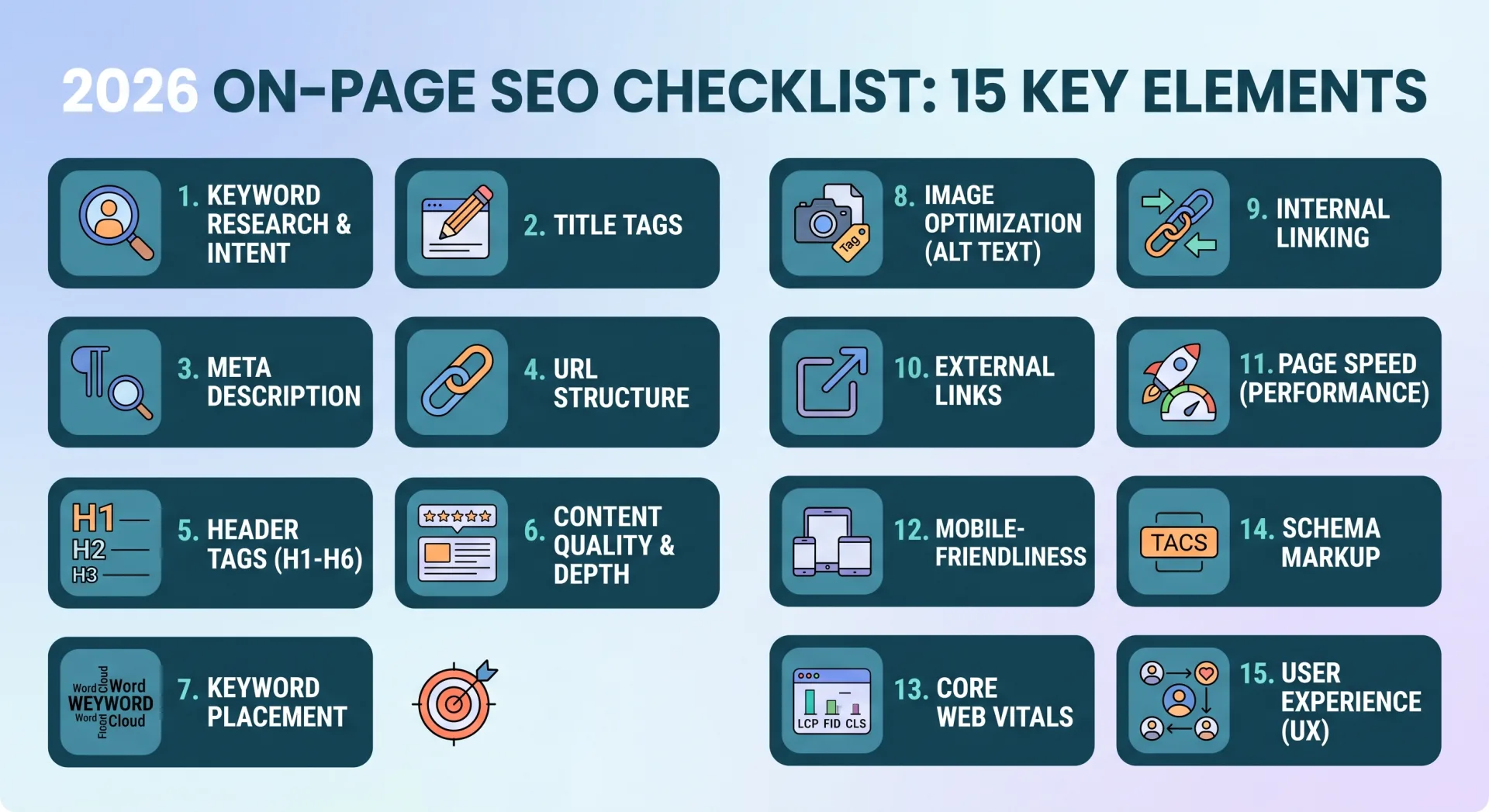
The Most Important Schema Markup Types in 2026
Google supports a defined collection of structured-data features for Search. The appropriate schema type depends on what the page actually represents.
Article Schema
Article structured data can help Google understand article-related information such as the headline, author, publication date, modification date, and images.
{
  "@context": "https://schema.org",
  "@type": "Article",
  "@id": "https://example.com/article/#article",
  "headline": "Schema Markup in 2026",
  "datePublished": "2026-09-08",
  "dateModified": "2026-09-08",
  "author": {
    "@type": "Person",
    "name": "Jane Doe",
    "url": "https://example.com/author/jane-doe/"
  }
}
BreadcrumbList Schema
Breadcrumb structured data describes the hierarchical location of a page and can help Google understand the relationship between the page and its parent sections.
{
  "@context": "https://schema.org",
  "@type": "BreadcrumbList",
  "itemListElement": [
    {
      "@type": "ListItem",
      "position": 1,
      "name": "SEO",
      "item": "https://example.com/seo/"
    },
    {
      "@type": "ListItem",
      "position": 2,
      "name": "Schema Markup",
      "item": "https://example.com/seo/schema-markup/"
    }
  ]
}
Organization Schema
Organization structured data describes an organization and can include information such as its name, logo, URL, contact details, and other relevant identifiers.
It is particularly useful for establishing a consistent identity for the organization behind a website.
LocalBusiness Schema
LocalBusiness structured data is intended for businesses with a physical or local presence. Use the most specific applicable subtype whenever possible.
Depending on the business, appropriate subtypes can include entities such as Restaurant, Store, or another applicable local-business type.
Product Schema
Product structured data is especially important for ecommerce websites. It can describe products and information such as product names, images, brands, offers, prices, availability, and qualifying review information.
Product structured data should accurately represent the specific product or product variants shown on the page. Do not use generic product markup on pages that do not actually represent the corresponding product.
Review and AggregateRating Schema
Review structured data can support eligible review snippets when the page contains genuine review content and satisfies Google's requirements.
{
  "@context": "https://schema.org",
  "@type": "Product",
  "name": "Example Product",
  "aggregateRating": {
    "@type": "AggregateRating",
    "ratingValue": "4.7",
    "ratingCount": "128"
  }
}
Ratings and reviews must be genuine and accurately represented. Never create artificial ratings or mark up information that does not exist on the page.
ProfilePage Schema
ProfilePage structured data is relevant to pages primarily focused on a particular person or organization, such as author profiles, creator pages, employee profiles, or community profiles.
Video Schema
Video structured data can describe important information about videos, including titles, thumbnails, descriptions, upload dates, and duration.
It is most useful when the video is genuinely an important part of the page rather than an unrelated embedded video.
Event Schema
Event structured data is designed for genuine events that occur at a particular time and place. Relevant information can include the event name, date, location, organizer, status, and ticket information.
SoftwareApplication Schema
SoftwareApplication structured data can describe software such as mobile applications, desktop applications, games, and other qualifying software products.
Q&A and Discussion Forum Schema
Google also supports structured-data features for certain Q&A and discussion-oriented pages. These should only be used when the page genuinely represents the corresponding content model.
FAQ Schema in 2026: What Changed?
Google has officially restricted FAQPage structured data visibility in search results. FAQ rich snippets now appear almost exclusively for authoritative government, healthcare, and educational domains. For general business websites, focus your schema strategy on Article, Product, Organization, BreadcrumbList, and LocalBusiness schemas.
FAQ schema is one of the areas where older SEO advice can be particularly misleading.
Google previously displayed FAQ rich results for qualifying pages using FAQPage structured data. That feature was significantly restricted and ultimately removed from Google Search.
As of 2026, publishers should not implement FAQ schema with the expectation of receiving the old expandable FAQ search-result treatment.
FAQ content can still be valuable for users, but the old Google FAQ rich-result strategy should not be treated as a current CTR tactic.
What Happened to HowTo Schema?
Google's How-to rich result was also removed from Search. As a result, adding HowTo markup should not be viewed as a way to obtain the former How-to rich-result presentation.
Tutorials and step-by-step content can still be extremely valuable. The important distinction is between the usefulness of the content itself and eligibility for a specific Google Search feature.
Why Schema.org and Google's Search Features Are Not the Same
Schema.org is much broader than Google's structured-data requirements for Search.
A Schema.org type can be valid and meaningful without producing a Google rich result.
This is one of the most important concepts in modern structured-data SEO:
Schema.org validity does not automatically equal Google rich-result eligibility.
How to Implement Schema Markup Step by Step
Step 1: Identify the Primary Entity
Start by determining what the page is primarily about.
- Article
- Product
- Event
- LocalBusiness
- Organization
- ProfilePage
- Recipe
- Q&A page
The primary schema type should reflect the actual purpose of the page.
Step 2: Check Google's Current Requirements
Before implementing markup, check Google's current documentation for the specific search feature you are targeting.
Pay particular attention to required properties, recommended properties, content policies, technical requirements, and feature availability.
Step 3: Collect Accurate Information
Every important property should be based on real information represented on the page.
For example, a product page should use the actual product name, price, currency, availability, and qualifying review information rather than placeholder or fabricated values.
Step 4: Add JSON-LD
Add the structured data to the HTML using JSON-LD.
<script type="application/ld+json">
{
  "@context": "https://schema.org",
  "@type": "Article",
  "headline": "Schema Markup in 2026"
}
</script>
Step 5: Validate the Structured Data
Use Google's Rich Results Test to determine whether your page contains structured data that can potentially support Google's rich-result features.
You can also use the Schema Markup Validator to check the broader Schema.org structure.
Step 6: Inspect the Live URL
After publishing the markup, inspect the live page and make sure Google can crawl and process the page correctly.
Step 7: Monitor Search Console
Once Google has crawled and processed the updated page, monitor Search Console for structured-data issues and changes in search performance.
Valid Schema Does Not Guarantee a Rich Result
This is one of the most important distinctions to understand.
A page can have technically valid JSON-LD and still display as a normal search result.
The process is better understood as:
- Valid structured-data syntax
- Valid Schema.org implementation
- Google feature eligibility
- Google crawling and processing
- Potential rich-result display
Each stage is different, and passing one stage does not guarantee the next.
Should You Use @graph?
Instead of declaring disparate, unlinked JSON-LD script blocks, wrap all schemas inside a single "@graph": [...] array. Connect your WebPage to your Article, your Author (Person), and your Publisher (Organization) using consistent @id URIs to build a unified Knowledge Graph node.
The @graph structure can be useful for websites with multiple related entities.
For example, an article page can connect an Article to its author and publisher while maintaining stable identifiers for those entities.
{
  "@context": "https://schema.org",
  "@graph": [
    {
      "@type": "Organization",
      "@id": "https://example.com/#organization",
      "name": "Example Media",
      "url": "https://example.com/"
    },
    {
      "@type": "Person",
      "@id": "https://example.com/author/jane-doe/#person",
      "name": "Jane Doe"
    },
    {
      "@type": "Article",
      "@id": "https://example.com/article/#article",
      "headline": "Schema Markup in 2026",
      "author": {
        "@id": "https://example.com/author/jane-doe/#person"
      },
      "publisher": {
        "@id": "https://example.com/#organization"
      }
    }
  ]
}
Using @graph is not mandatory, but it can make complex implementations easier to organize and connect.
Common Schema Markup Mistakes
Never include data in your JSON-LD that is not visible to human users in the rendered HTML. Marking up hidden reviews, fake pricing, or non-existent author credentials directly violates Google Search Essentials and will result in a Structured Data Manual Action.
Adding Schema Only to Improve Rankings
Schema markup should not be treated as a direct ranking shortcut. Its value is primarily related to machine-readable understanding and eligibility for supported search features.
Marking Up Hidden or Inaccurate Content
Structured data should accurately represent information available to users on the page. Do not use structured data to provide search engines with information that contradicts or does not exist in the visible content.
Using the Wrong Schema Type
Do not mark a blog article as a Product simply because product pages can receive attractive search features. Use the type that genuinely describes the page.
Adding Too Many Schema Types
More schema does not necessarily mean better SEO.
A page containing Article, Product, Recipe, Event, JobPosting, LocalBusiness, and other unrelated types is not automatically more authoritative. If those entities are not genuinely represented on the page, the implementation is misleading.
Creating Fake Ratings
Never invent ratings or reviews for the purpose of generating review snippets. Ratings should represent genuine information supported by the page and satisfy Google's applicable requirements.
Using Outdated Schema Strategies
Search features change. Strategies based on retired features such as the old FAQ and How-to rich results should not be treated as current SEO best practices.
Schema Markup for Different Website Types
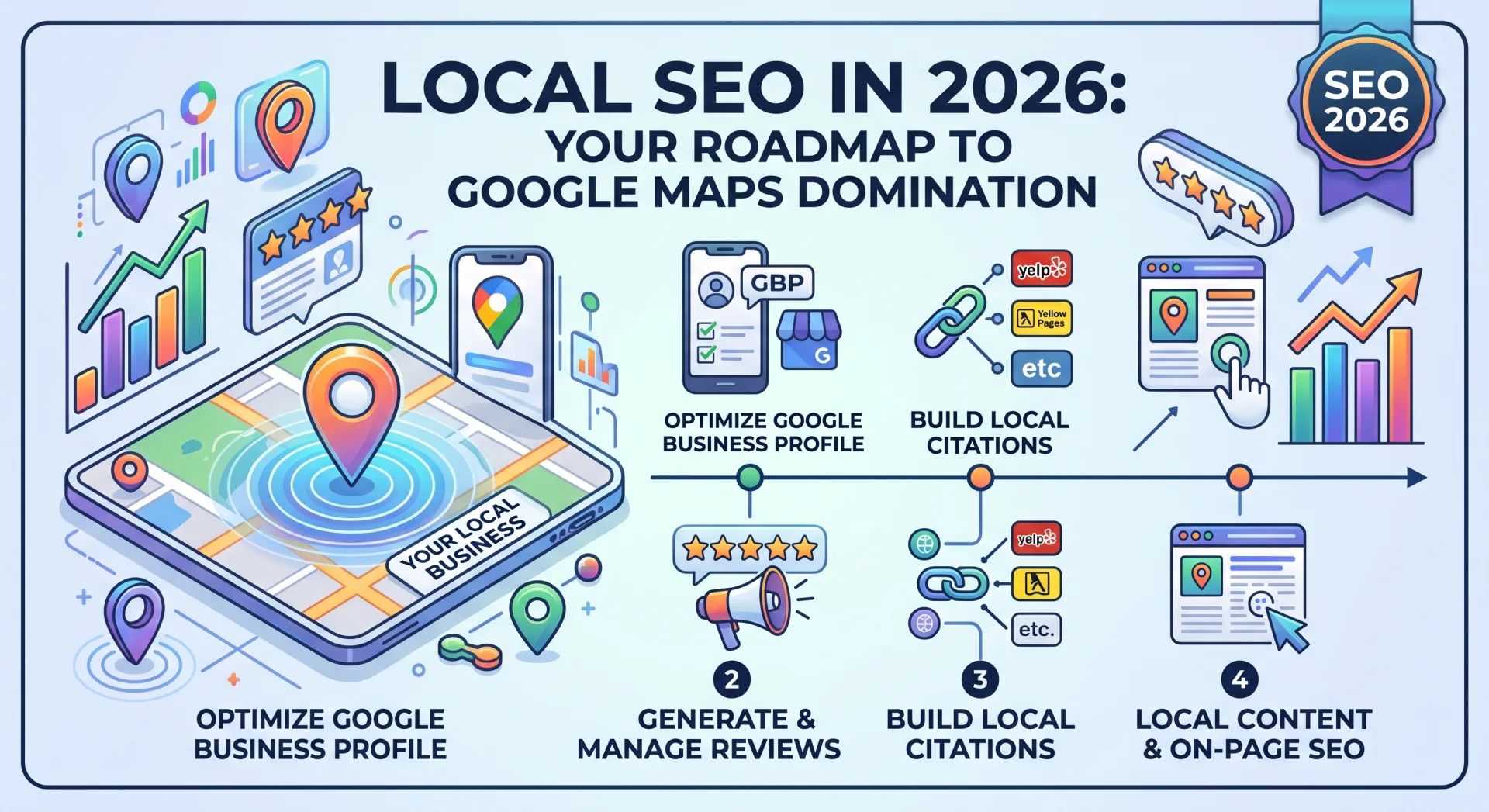
For service-area businesses and local stores, structured data must tie directly into local search visibility. Learn how to configure LocalBusiness entities alongside Google Business Profile in our guide on Local SEO and Google Maps optimization.
Blog and Publishing Websites
- Article
- Person or ProfilePage where appropriate
- Organization
- BreadcrumbList
- VideoObject when relevant
Ecommerce Websites
- Product
- Organization
- BreadcrumbList
- Review where applicable
- VideoObject where relevant
Local Business Websites
- LocalBusiness or an appropriate subtype
- Organization
- BreadcrumbList
- Review where applicable
- Event where applicable
SaaS and Software Websites
- SoftwareApplication
- Organization
- Review where applicable
- BreadcrumbList
Should Every Page Have Schema Markup?
No. Schema markup should be implemented where it accurately describes the page and provides a meaningful semantic or search-related benefit.
A practical page-type strategy might look like this:
| Page Type | Potential Primary Schema |
|---|---|
| Homepage | Organization and relevant site-level entities |
| Blog article | Article |
| Author page | ProfilePage |
| Product page | Product |
| Local business page | LocalBusiness subtype |
| Event page | Event |
| Question and answer page | QAPage when applicable |
Automated Schema vs. Manual Schema
Automated Schema
Automated structured data is particularly useful for large websites, ecommerce catalogs, publishing platforms, and websites with standardized page templates.
The main advantage is scalability. The main risk is that one incorrect template can create thousands of incorrect schema implementations.
Manual Schema
Manual implementation provides more control and can work well for smaller websites or unusual pages, but it becomes harder to maintain as the website grows.
For most larger websites, the strongest approach is template-driven automation combined with carefully defined schema rules.
Schema Markup and JavaScript
Modern websites can generate structured data dynamically with JavaScript. However, server-rendered JSON-LD in the initial HTML can often make implementation, debugging, and crawling easier.
If your website generates schema dynamically, test the final rendered page rather than assuming that the source code and rendered HTML are identical.
Schema Markup, Images, and Entity Information
Images can be important components of structured-data implementations, particularly for articles, products, recipes, and videos.
Image URLs referenced by structured data should be accessible to search engines and should accurately represent the content they are associated with.
Similarly, authors, organizations, products, brands, and other entities should be represented consistently across the website where appropriate.
Canonical URLs and Structured Data
Structured data should describe the page on which it appears and should remain consistent with the page's actual content and URL relationships.
If multiple pages represent the same content, make sure the structured data does not introduce contradictory entity information across those pages.

How to Troubleshoot Schema Markup
My Schema Is Valid but No Rich Result Appears
This does not necessarily indicate an implementation problem. Google can choose not to display a rich result even when the page is eligible.
Search Console Reports Invalid Structured Data
Check the affected URLs, identify the specific property or requirement causing the issue, correct the implementation, and validate the updated page again.
My Valid Items Suddenly Decreased
Investigate recent changes to your CMS, theme, plugins, templates, structured-data generation, indexing, and page URLs. A template change can affect hundreds or thousands of pages simultaneously.
I Have Duplicate Schema
Duplicate schema often occurs when a theme, SEO plugin, and dedicated schema plugin all generate markup for the same entity.
Inspect the final HTML and determine which system should be responsible for each structured-data component.
How to Measure Schema SEO Performance
The best way to evaluate structured-data performance is to connect implementation changes with actual search data rather than assuming that a valid schema implementation is successful.
Measure Search Visibility
Track impressions and average position before and after implementation.
Measure CTR
Compare CTR for relevant pages and queries while taking ranking position into account.
Measure Business Outcomes
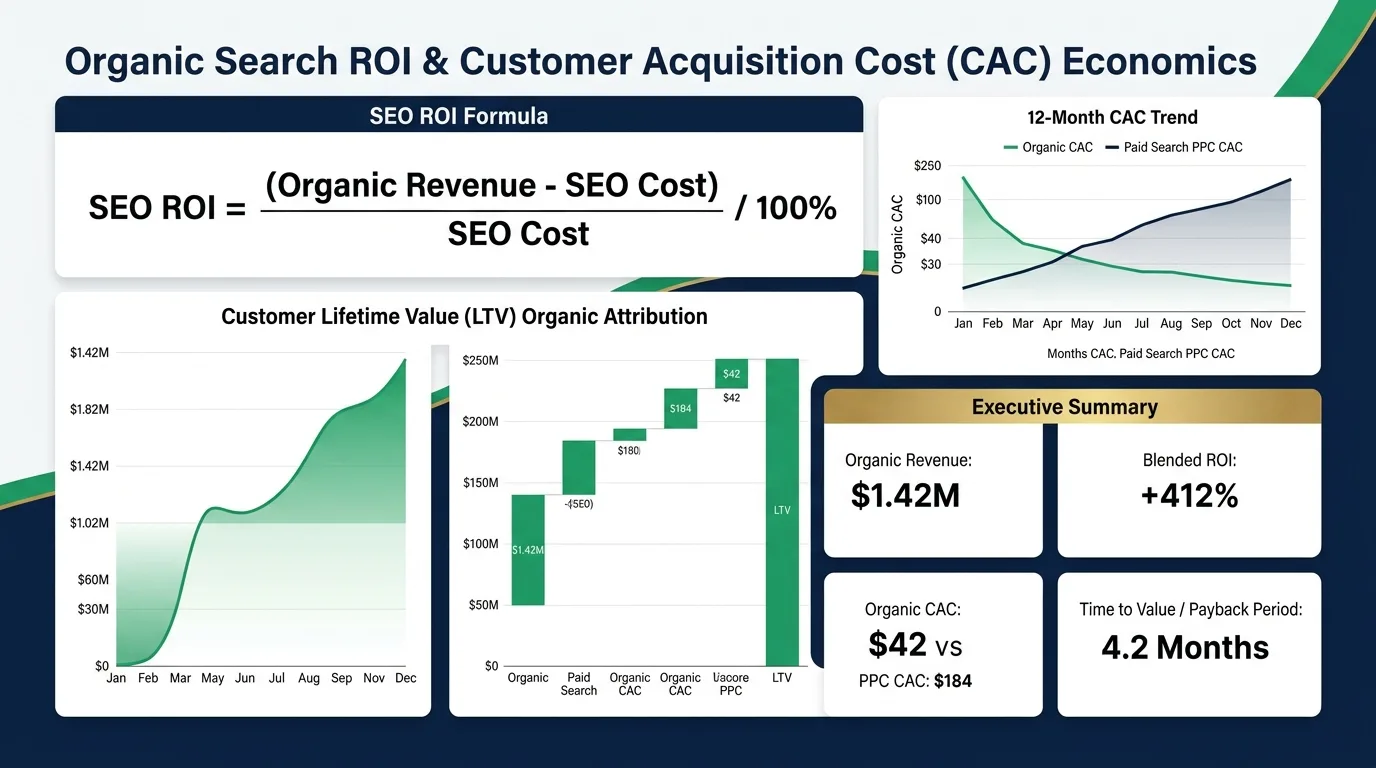
CTR is not the final objective for most websites. Depending on the business, also measure:
- Organic traffic
- Qualified visits
- Leads
- Transactions
- Revenue
- Conversions
An Advanced Schema Strategy for 2026
A mature schema strategy should be based on entities, relationships, accuracy, and maintainability rather than simply counting how many schema types exist on a page.
A useful hierarchy is:
- Identify the primary entity.
- Add the supporting entities.
- Connect entities using meaningful relationships.
- Use stable identifiers where appropriate.
- Validate against current Google requirements.
- Monitor the implementation after deployment.
What Schema Markup Cannot Fix
Structured data is not a substitute for good SEO fundamentals.
Schema cannot fix:
- Poor content quality
- Incorrect search intent targeting
- Weak internal linking
- Indexing problems
- Incorrect canonicalization
- Slow or unstable pages
- Weak titles and snippets
- Poor user experience
- Low-quality products or services
A page with perfect JSON-LD can still perform poorly if the underlying content does not satisfy the searcher's needs.
Schema Markup and AI Search in 2026
The growth of generative search experiences makes machine-readable information increasingly relevant, but schema should not be presented as an "AI search ranking hack."
A better approach is to use structured data as one component of a broader machine-understanding strategy that includes clear content, consistent entities, accessible technical architecture, and strong topical coverage.
The goal is not to optimize only for a particular search interface. It is to make the meaning and structure of your website easier for machines to understand while continuing to create genuinely useful content for people.
Schema Markup Best Practices for 2026
- Use the most appropriate schema type.
- Prefer JSON-LD for most implementations.
- Make structured data match visible page content.
- Use genuine information instead of fabricated values.
- Check Google's current Search documentation.
- Do not rely on retired rich-result features.
- Avoid unnecessary schema duplication.
- Use stable entity identifiers where appropriate.
- Validate before and after deployment.
- Monitor structured-data reports in Search Console.
- Measure actual search performance instead of assuming CTR improvements.
Final Thoughts
Schema markup remains an important part of modern technical SEO, but its role has become more nuanced. The strongest implementations are not built around the idea that adding structured data automatically produces higher rankings or more clicks.
Instead, schema should accurately describe the page, its entities, and their relationships. When that implementation satisfies Google's current requirements, it can make eligible content capable of appearing in enhanced search experiences.
The most important lesson for 2026 is simple: do not optimize for the amount of schema you have; optimize for the accuracy and usefulness of the information you provide.
Validate your implementation, monitor it after deployment, keep it synchronized with your visible content, and measure its effect using real Search Console and business data. That approach is far more sustainable than chasing individual rich-snippet hacks.
What is schema markup?
Schema markup is structured data that uses a standardized vocabulary such as Schema.org to describe the content, entities, and relationships represented on a web page. Search engines can use this information to better understand the page and, when applicable, determine eligibility for enhanced search features.
Does schema markup improve Google rankings?
Schema markup should not be treated as a direct ranking boost. Its primary SEO purpose is to provide structured information that can help search engines understand content and can make eligible pages capable of appearing in supported rich-result experiences.
Can schema markup increase CTR?
It can potentially improve CTR when structured data leads to a more useful or prominent search appearance, but Google does not guarantee that an eligible rich result will appear. CTR should be measured using actual Search Console data.
Is JSON-LD better than Microdata?
JSON-LD is generally the preferred choice for modern implementations because it is easier to separate from the visible HTML structure and is typically easier to maintain. Google also supports Microdata and RDFa.
Should every page have schema markup?
No. Structured data should be used when it accurately describes the page and its entities. The correct approach is to implement schema according to page type and relevance rather than adding markup to every page simply for SEO purposes.
Is FAQ schema still useful for Google rich results in 2026?
You should not use FAQ schema expecting the old Google FAQ rich-result treatment. Google removed that Search feature in 2026. FAQ content itself can still be useful to readers, but it should not be treated as a guaranteed rich-result or CTR tactic.
Does valid schema guarantee a rich result?
No. Valid structured data can make a page eligible for a supported rich result, but Google decides whether and when to display the enhanced search appearance.
How can I test my schema markup?
Google's Rich Results Test can be used to check eligibility for supported rich-result features. The Schema Markup Validator can also be used to validate Schema.org structured data more generally.
What is the most important schema markup best practice in 2026?
The most important practice is accuracy. Your structured data should accurately describe the visible content and entities on the page, use an appropriate schema type, follow Google's current feature requirements, and be maintained as the page changes.


Ratings & reviews
No reviews yet. Be the first.