
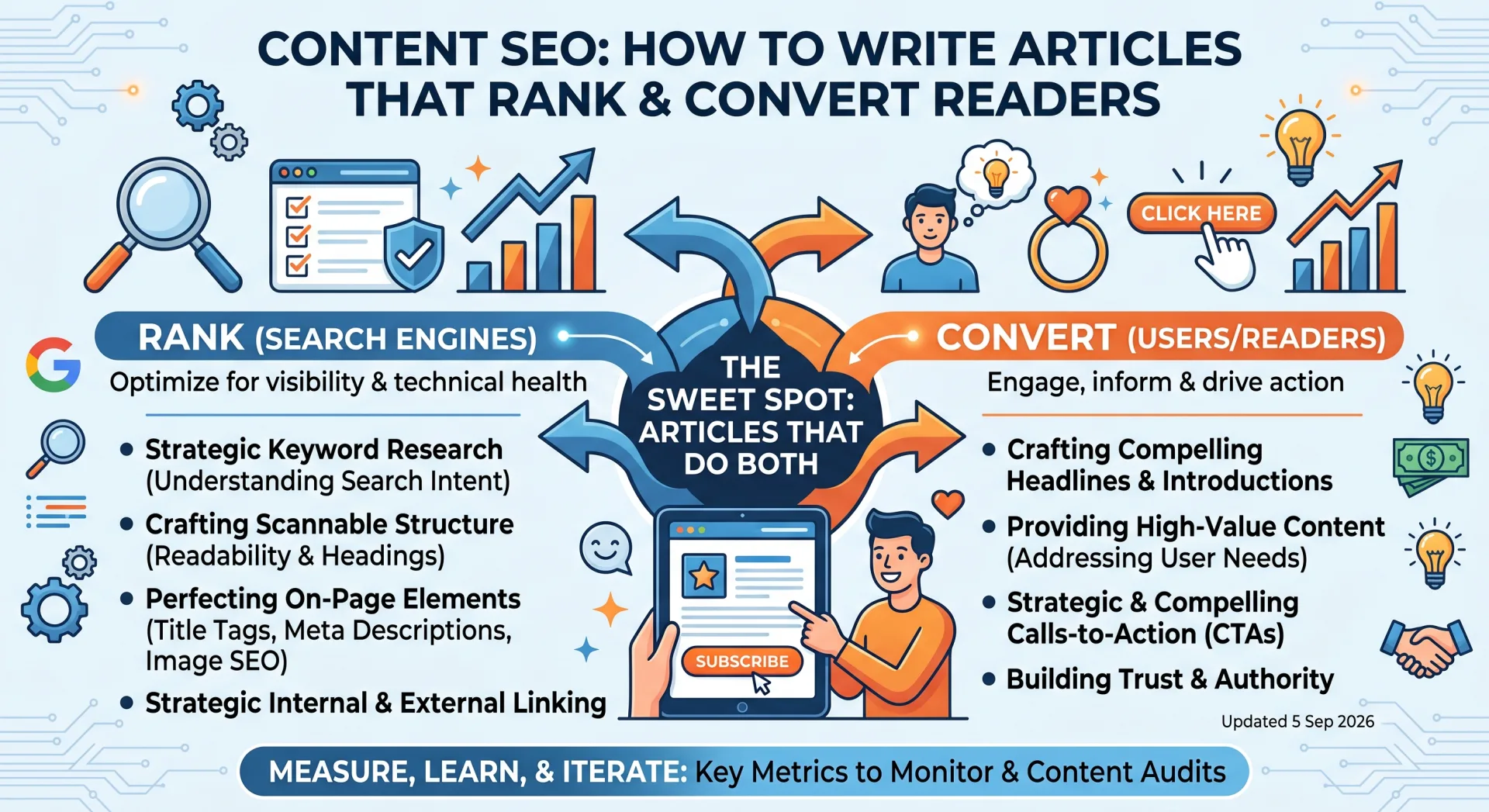
In the competitive digital landscape, merely creating content is no longer enough. To truly succeed, your articles must not only attract search engine attention but also captivate and convert your human readers. This delicate balance between technical SEO optimization and compelling, user-focused writing is the essence of effective content SEO. This guide will walk you through the practical strategies to craft articles that rank high on search engine results pages (SERPs) and simultaneously drive meaningful engagement and conversions, ensuring your content works harder for your business.
Achieving this dual objective requires a holistic approach, integrating keyword research, on-page optimization, and a deep understanding of user intent with persuasive writing techniques. We'll explore how to structure your content for readability and search engine crawlability, how to strategically place keywords without sacrificing flow, and how to write headlines and calls to action that compel users to interact further. By mastering these techniques, you'll transform your content from static text into a powerful tool for organic growth and business success.
Understanding Content SEO: More Than Just Keywords
Content SEO is the practice of creating and optimizing web content to rank highly in search engine results for specific keywords and topics. However, it's a common misconception that content SEO is solely about keyword stuffing or technical optimizations. While keywords and technical elements are crucial, true content SEO encompasses a broader strategy that prioritizes user experience, relevance, and authority. It's about providing the best possible answer to a user's query, presented in an accessible and engaging format.
The goal of search engines like Google is to deliver the most relevant and highest-quality results to their users. Therefore, your content SEO strategy must align with this goal. This means creating content that isn't just optimized for algorithms but is genuinely valuable, informative, and enjoyable for human readers. When search engines perceive your content as a valuable resource, they are more likely to rank it higher, leading to increased organic traffic and improved opportunities for conversion.
The Interplay of Search Engines and Users
Search engines use complex algorithms to assess the quality and relevance of your content. These algorithms consider hundreds of ranking factors, including keyword usage, content structure, readability, internal and external links, site speed, mobile-friendliness, and user engagement metrics like bounce rate and time on page. A strong content SEO strategy addresses all these elements, ensuring your content is both technically sound and user-centric.
Ultimately, a positive user experience signals to search engines that your content is valuable. If users find what they're looking for quickly, spend time reading your article, and then proceed to other relevant pages on your site, these are strong indicators of quality. Conversely, if users quickly bounce back to the search results, it can negatively impact your rankings. Therefore, balancing SEO requirements with compelling writing is not just an ideal; it's a necessity for sustained success.
Strategic Keyword Research and Intent Mapping
The foundation of any successful content SEO strategy lies in thorough keyword research. This process goes beyond simply finding high-volume keywords; it involves understanding the intent behind those keywords and how they relate to your target audience's needs and questions. By mapping keywords to user intent, you can create content that directly addresses what your potential customers are searching for.
Start by brainstorming broad topics relevant to your business and target audience. Then, use keyword research tools to identify specific terms and phrases associated with those topics. Look for a balance of high-volume, competitive keywords and long-tail keywords that might have lower search volume but often indicate stronger purchase intent. Pay close attention to related keywords and questions that users are asking, as these can uncover valuable content opportunities.
Understanding User Intent
User intent is the primary goal a user has when typing a query into a search engine. There are generally four main types of search intent:
- Informational: Users are looking for information (e.g., "how to bake bread," "what is content SEO").
- Navigational: Users are trying to find a specific website or page (e.g., "Google Maps," "Amazon login").
- Transactional: Users intend to complete an action, often a purchase (e.g., "buy running shoes online," "best CRM software price").
- Commercial Investigation: Users are researching products or services with the intent to buy in the near future (e.g., "best laptops for students," "CRM software reviews").
Your content must align with the intent of the keywords you are targeting. For informational queries, create comprehensive guides, tutorials, or explanatory articles. For transactional or commercial investigation queries, focus on product pages, service descriptions, or comparison articles that highlight benefits and features. Misaligning content with intent can lead to high bounce rates, as users quickly realize your page isn't what they were looking for.
Practical Keyword Implementation
Once you have a list of target keywords and understand their intent, strategically integrate them into your content. Your primary keyword should appear in your article title (H1), meta description, introductory paragraphs, and throughout the body naturally. Use secondary keywords and related terms to enrich your content and provide context, helping search engines understand the broader topic.
Avoid keyword stuffing at all costs. Overusing keywords can make your content read unnaturally and may even lead to penalties from search engines. Focus on natural language and providing value to the reader.
Crafting Engaging and Rank-Worthy Content
With your keyword strategy in place, the next step is to write the content itself. This is where the art of writing meets the science of SEO. Your goal is to create articles that are not only optimized for search engines but also compelling, informative, and enjoyable for your human audience. Engaging content keeps readers on your page longer, reduces bounce rates, and encourages them to take desired actions.
Structure for Readability and SEO
Well-structured content benefits both readers and search engines. For readers, it makes the article easy to scan and digest. For search engines, a clear structure helps them understand the hierarchy and main topics of your content. Use headings and subheadings (H2, H3, H4) to break up large blocks of text and organize your points logically. Each heading should accurately reflect the content of the section below it.
Incorporate bullet points, numbered lists, and short paragraphs to improve readability. These elements make your content less intimidating and easier to skim, which is how many users consume online information. Don't be afraid of white space; it gives the reader's eyes a break and improves overall visual appeal.
Writing Compelling Headlines and Introductions
Your headline (title tag and H1) is your first impression. It needs to be catchy, include your primary keyword, and accurately reflect the content of your article. A strong headline entices users to click from the SERPs and encourages them to continue reading once they're on your page. Similarly, your introduction should hook the reader immediately, clearly state what the article will cover, and explain why it's relevant to them.
Use power words, numbers, and questions in your headlines to grab attention. For introductions, start with a compelling statistic, a relatable problem, or a bold statement. The goal is to make the reader feel like your article is precisely what they need to solve their problem or answer their question.
On-Page Optimization Beyond Keywords
While keyword placement is important, on-page SEO encompasses a range of other elements that contribute to your article's visibility and performance. These technical and structural optimizations signal to search engines the relevance and quality of your content.
Meta Descriptions and Title Tags
Your title tag is a crucial SEO element that appears in the browser tab and as the clickable headline in search results. It should be concise (under 60 characters), include your primary keyword, and accurately describe the page's content. The meta description is the short paragraph that appears below the title in search results. While not a direct ranking factor, a compelling meta description can significantly improve click-through rates (CTR) by summarizing your content and enticing users to click. Include your primary keyword and a strong call to action if possible.
<head>
    <title>Content SEO: How to Write Articles That Rank and Convert Readers</title>
    <meta name="description" content="Master content SEO to write articles that not only rank high on Google but also engage and convert your audience. Learn practical SEO writing strategies.">
</head>
This example shows how to integrate the title tag and meta description within the HTML <head> section of your web page, optimizing for both keywords and user appeal.
Image Optimization
Images enhance readability and engagement, but they also offer SEO opportunities. Optimize your images by compressing them to reduce file size, which improves page load speed. Use descriptive file names (e.g., content-seo-strategy.jpg instead of IMG001.jpg) and fill in the alt text attribute with a brief, descriptive phrase that includes relevant keywords. Alt text helps search engines understand the image content and improves accessibility for visually impaired users.
Internal and External Linking
Strategic linking is vital for SEO. Internal links connect different pages within your website, helping search engines discover and index your content, and distributing "link equity" throughout your site. They also guide users to related content, increasing time on site and reducing bounce rates. Use descriptive anchor text that includes keywords relevant to the linked page.
External links (outbound links) to authoritative, relevant sources can demonstrate your content's credibility and provide additional value to your readers. However, ensure you link to high-quality, reputable sites. Avoid linking to low-quality or irrelevant websites, as this can negatively impact your own site's authority.
Measuring Performance and Iterating for Success
Content SEO is not a one-time task; it's an ongoing process of creation, optimization, analysis, and iteration. To ensure your articles continue to rank and convert, you must regularly monitor their performance and be prepared to make adjustments based on data.
Key Metrics to Monitor
Utilize tools like Google Analytics and Google Search Console to track critical metrics:
- Organic Traffic: How many users are finding your content through search engines?
- Keyword Rankings: Where do your target keywords rank in search results?
- Click-Through Rate (CTR): The percentage of users who clicked on your article from the SERPs.
- Bounce Rate: The percentage of users who leave your site after viewing only one page.
- Time on Page: How long users spend engaging with your content.
- Conversion Rate: The percentage of users who complete a desired action (e.g., sign up for a newsletter, make a purchase).
Analyzing these metrics provides insights into what's working and what needs improvement. For example, a low CTR might indicate a weak title or meta description, while a high bounce rate could suggest that your content isn't meeting user intent or is poorly structured.
Content Audits and Updates
Regularly conduct content audits to identify underperforming articles or opportunities for improvement. Update outdated information, add new insights, refresh statistics, and enhance existing content with new keywords or multimedia elements. This process, known as content refreshing, can significantly boost rankings and traffic. Google favors fresh, up-to-date content, especially for informational queries.
Consider repurposing content into different formats (e.g., turning a blog post into an infographic or video) to reach a wider audience and extend its lifespan. Each iteration provides new opportunities for optimization and engagement.
Conclusion
Mastering content SEO is about more than just appeasing search engine algorithms; it's about creating genuinely valuable and engaging experiences for your audience. By integrating strategic keyword research, meticulous on-page optimization, and a commitment to high-quality, user-centric writing, you can produce articles that not only rank prominently in search results but also effectively convert readers into loyal customers or subscribers.
Remember that the digital landscape is constantly evolving, so continuous learning, adaptation, and data-driven decision-making are paramount. Regularly analyze your content's performance, refine your strategies, and always prioritize delivering the best possible information to your readers. By doing so, your content will become a powerful asset, driving sustainable organic growth and achieving your business objectives.
What is the main difference between content writing and content SEO?
Content writing focuses on creating engaging, high-quality text for readers. Content SEO incorporates content writing principles but adds a layer of optimization specifically for search engines, including keyword research, on-page optimization, technical elements, and strategic structuring, all aimed at improving search rankings and visibility.
How often should I update my content for SEO?
The frequency depends on the topic and its evergreen nature. Highly competitive or rapidly changing topics (e.g., tech reviews, news) might need monthly or quarterly updates. Evergreen content (e.g., "how-to" guides, foundational concepts) might only need annual or bi-annual reviews. A good practice is to audit your content regularly (e.g., every 6-12 months) and update as needed to maintain relevance and accuracy.
Can I rank without using popular keywords?
Yes, by focusing on long-tail keywords. These are longer, more specific phrases that typically have lower search volume but also less competition and often higher conversion rates because they indicate more specific user intent. While they won't bring massive traffic individually, a collection of well-ranking long-tail keyword articles can generate significant, highly qualified traffic.
What role does user experience (UX) play in content SEO?
UX plays a critical role. Search engines increasingly use user signals (like bounce rate, time on page, and click-through rate) as ranking factors. If users have a poor experience on your page (e.g., slow loading, difficult to read, irrelevant content), they will quickly leave, signaling to search engines that your content may not be high quality or relevant, thus negatively impacting your rankings.
Should I write for search engines or for humans?
You should write for humans first, with search engines in mind. Your primary goal is to provide value to your readers. If your content is well-written, informative, and engaging for humans, it will naturally incorporate many of the elements that search engines look for. Then, you layer on strategic SEO optimizations (keywords, structure, technical elements) to help search engines discover and understand that value.
Is it possible to convert readers directly from an informational blog post?
Absolutely. While informational posts primarily aim to educate, they are excellent opportunities for soft conversions. This can include encouraging newsletter sign-ups, downloading a related lead magnet (e.g., an ebook or checklist), or guiding them to relevant product/service pages through internal links and clear calls to action. The key is to offer the next logical step that aligns with their informational journey.


Ratings & reviews
No reviews yet. Be the first.