

The fundamental architecture of organic web search is undergoing its most radical transformation since the invention of the hyperlink. For over twenty-five years, traditional search engine optimization (SEO) operated on a predictable paradigm: search bots crawled HTML strings, inverted indices cataloged keyword frequencies using BM25 algorithms, and PageRank calculated domain authority to rank ten blue links on a two-dimensional search engine results page (SERP). In 2026, that paradigm has been definitively superseded by Generative Engine Optimization (GEO).
Today, users no longer simply click through links to manually compile answers across fragmented web pages. Instead, conversational answer engines—led by OpenAI's SearchGPT, Perplexity AI, Google's AI Overviews (formerly Search Generative Experience / SGE), and Anthropic's Claude Artifacts—synthesize real-time, multifaceted answers directly in the user's viewport. These generative models do not simply match lexical keyword strings; they deploy dense vector embeddings, multidimensional semantic spaces, and Retrieval-Augmented Generation (RAG) to retrieve, synthesize, and attribute authoritative sources.
For digital brands, technical architects, and enterprise publishers, the commercial stakes are existential. Websites optimized solely for legacy keyword density and traditional backlink volume are experiencing devastating click-through rate (CTR) declines, while pioneering entities engineering their digital footprint for machine readability, semantic entity authority, and high Information Gain are capturing monopolistic citation shares across AI search interfaces.
This comprehensive engineering handbook provides an exhaustive, definitive blueprint for mastering Generative Engine Optimization in 2026. From the mathematics of dense vector retrieval and cosine similarity to reverse-engineering SearchGPT ingestion pipelines, optimizing for Perplexity Pages, dominating Google AI Overviews, and deploying machine-readable JSON-LD entity graphs, this guide equips you to build an unshakeable competitive moat in the generative AI era.
Chapter 1: The Core Mechanics of Generative Engine Optimization (GEO) vs. Traditional SEO
To succeed in generative search, technical practitioners must unlearn the legacy mechanics of string-based search retrieval. Traditional SEO treated web documents as bags of words evaluated against sparse index scores. Conversely, Generative Engine Optimization operates entirely within continuous vector spaces and neural language models.
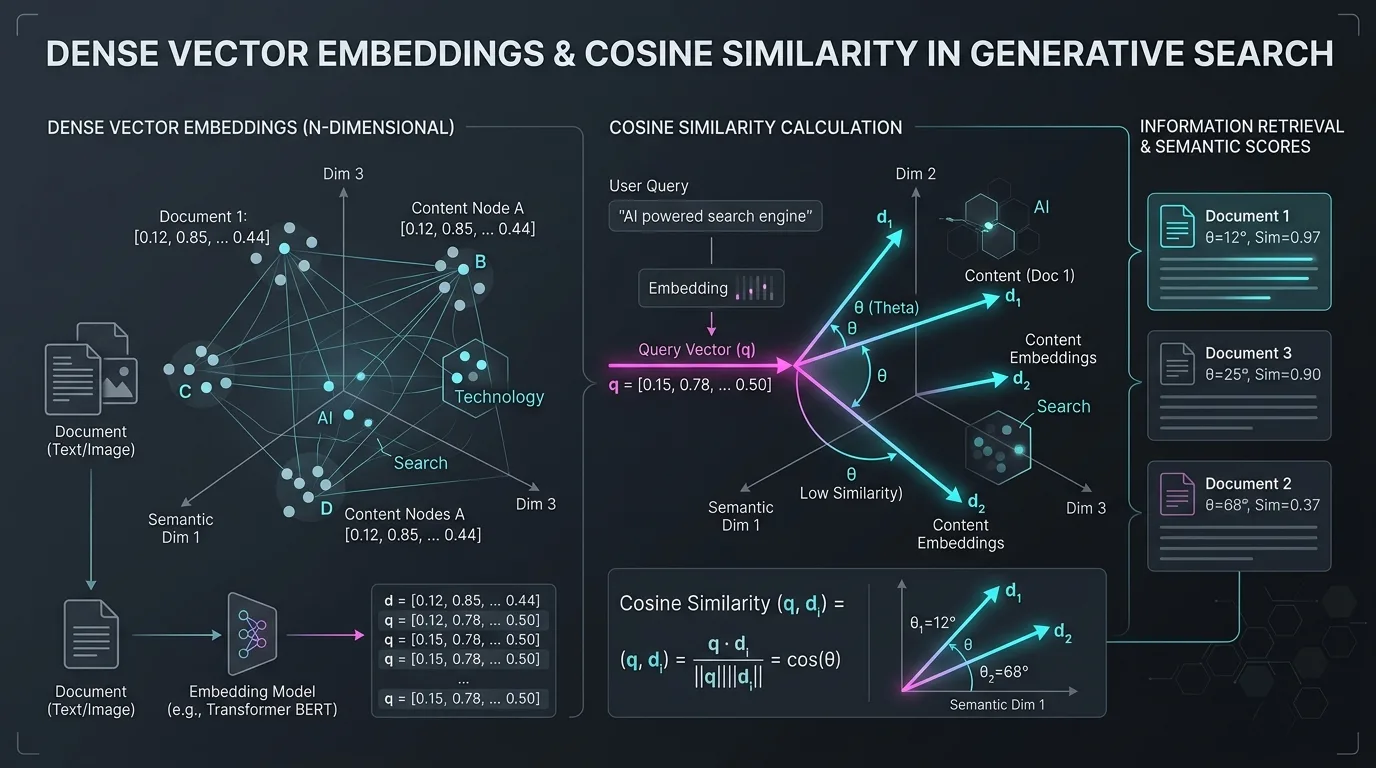
1. Sparse Retrieval (BM25) vs. Dense Vector Retrieval
Legacy search engines relied predominantly on BM25 (Best Matching 25), a probabilistic ranking function that calculates term frequency-inverse document frequency (TF-IDF). If a user searched for "enterprise cloud migration latency bottlenecks", BM25 searched for exact lexical matches or close morphological variations within indexed HTML documents.
Generative search engines utilize Dense Vector Retrieval powered by transformer-based bi-encoders (such as Google's Gecko, OpenAI's text-embedding-3-large, or ColBERT). Text documents and search queries are transformed into dense mathematical vectors consisting of 1,536 to 3,072 dimensions:
- Semantic Coordinate Mapping: Every sentence, paragraph, and concept is mapped to a specific coordinate point in high-dimensional vector space. Synonyms, related concepts, and conceptual answers cluster together regardless of lexical overlap.
- Cosine Similarity Calculation: When a user submits a prompt, the generative engine vectorizes the query (\(\mathbf{q}\)) and calculates the cosine of the angle (\( heta\)) between the query vector and candidate document chunk vectors (\(\mathbf{d}\)):
# Mathematical Representation of Semantic Cosine Similarity:
# cos(theta) = (q . d) / (||q|| * ||d||)

import numpy as np

def cosine_similarity(query_vector, doc_vector):
    dot_product = np.dot(query_vector, doc_vector)
    norm_q = np.linalg.norm(query_vector)
    norm_d = np.linalg.norm(doc_vector)
    return dot_product / (norm_q * norm_d)
If your content discusses "network transfer delays during multi-region database replication", a dense retrieval engine recognizes that your vector coordinate exhibits a 0.94 cosine similarity to "cloud migration latency bottlenecks", even if the exact keyword phrase appears zero times on your page.
Key Architectural Distinction: Traditional SEO optimized for exact strings and anchor text signals. Generative Engine Optimization optimizes for semantic vector proximity and factual entropy. Keyword stuffing in 2026 actually degrades vector precision by introducing semantic noise into your document embeddings.
2. The Structural Comparison: Traditional SEO vs. GEO
The operational differences between legacy search optimization and Generative Engine Optimization touch every layer of digital strategy:
| Operational Dimension | Traditional SEO (1998–2024) | Generative Engine Optimization (2026+) |
|---|---|---|
| Primary Objective | Rank on Page 1 (Top 10 Blue Links) | Become the Primary Cited Source in the Synthesized Answer |
| Indexing Technology | Inverted text index (lexical token matching) | High-dimensional vector databases & dense embeddings |
| Content Evaluation Metric | Keyword density, word count, TF-IDF | Information Gain score, semantic density, factual entropy |
| Authority Verification | External PageRank backlinks & anchor text | Knowledge Graph entity triples, cross-domain consensus, E-E-A-T |
| User Experience Metric | Pageviews, bounce rate, dwell time | Direct prompt resolution, source citation click-through, brand recall |
| Crawl Ingestion Unit | Full HTML document URL | Extracted semantic text chunks (250–500 token passages) |
Chapter 2: The End-to-End Retrieval-Augmented Generation (RAG) System
To optimize content for AI search engines, digital architects must thoroughly understand the Retrieval-Augmented Generation (RAG) pipeline that drives SearchGPT, Perplexity, and Google AI Overviews.
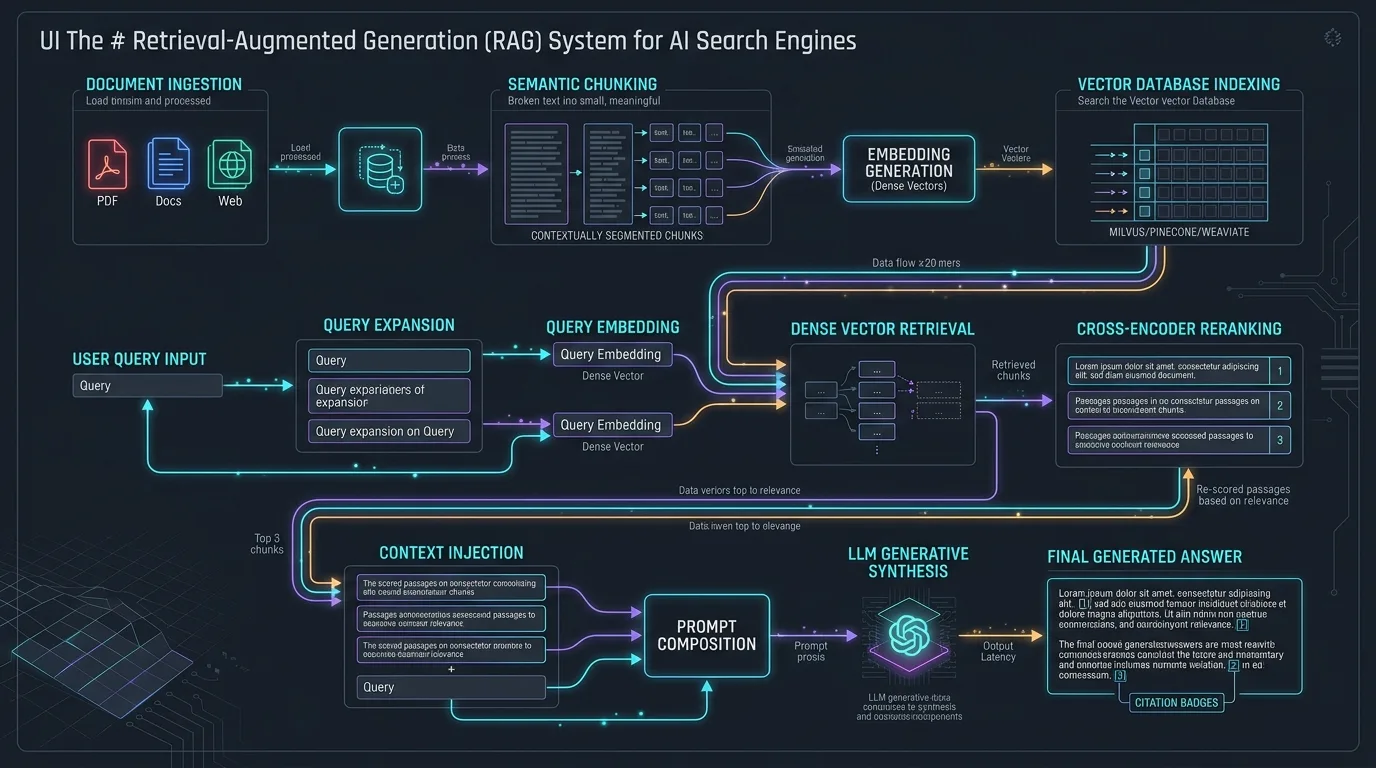
The RAG pipeline operates across eight discrete architectural stages:
- Document Ingestion & Clean Text Extraction: The AI search bot (e.g.,
OAI-SearchBotorGoogleOther) crawls the web page, strips boilerplate navigation, ads, and CSS styling, and extracts semantic HTML content (headings, paragraphs, lists, and structured tables). - Semantic Boundary Chunking: The engine segments the raw text into distinct passages, typically between 250 and 500 tokens. Sophisticated chunking algorithms identify logical boundaries (e.g.,
<h2>and<h3>breaks) rather than cutting text arbitrarily mid-sentence. - Embedding Generation & Vector Indexing: Each chunk is passed through an embedding neural network, generating a dense numerical vector stored in a specialized vector database (such as Milvus, Pinecone, or Google Vertex Vector Search).
- User Query Expansion & Decomposition: When a user asks a complex question, an orchestrator model decomposes the query into multiple sub-queries. For example, "What is the ROI of migrating to Next.js and how does it affect INP?" is decomposed into two distinct vector search queries.
- Dense Vector Candidate Retrieval: The vector database performs an Approximate Nearest Neighbor (ANN) search, rapidly identifying the top 50–100 candidate text chunks across the web exhibiting the highest cosine similarity.
- Cross-Encoder Reranking: Candidate chunks are evaluated by a computationally intensive cross-encoder model that scores passage relevance, freshness, domain trustworthiness, and Information Gain, narrowing the pool down to the top 3–7 winning context chunks.
- Prompt Composition & Context Injection: The winning passages are injected into the Large Language Model's system prompt alongside the user query: "Using ONLY the provided verified context chunks below, synthesize a comprehensive answer and provide bracketed citations [1], [2] referencing the source URLs."
- Generative Synthesis & Citation Badge Placement: The LLM streams the synthesized answer to the user, appending interactive citation pills, source domain icons, and deep-link fragments pointing directly to the quoted web passages.
Chapter 3: The Information Gain Score & High-Entropy Content Engineering
The single most decisive algorithmic factor governing whether your content is cited by an AI engine or completely discarded is the Information Gain Score. Originating from Google's groundbreaking patent ("Contextual Estimation of Information Gain", US Patent 11,048,740), this metric evaluates the unique incremental value a document provides over other documents the user or model has already consumed.
1. The Trap of Low-Entropy Commodity Content
For years, opportunistic SEO agencies generated billions of low-value blog posts by scraping the top 10 search results, rewriting the text with generative AI, and republishing the synthesized consensus. In traditional SEO, this often worked because keyword density and basic backlink authority were sufficient to rank.
In Generative Engine Optimization, commodity paraphrasing is fatal. Because LLMs are already trained on trillions of web tokens, they already possess internal parameter weights representing common knowledge. An AI model does not need to cite your website to state that "Core Web Vitals are important for SEO" or that "keyword research requires finding search volume." The LLM synthesizes common consensus from its base weights without triggering an external search retrieval or citation.
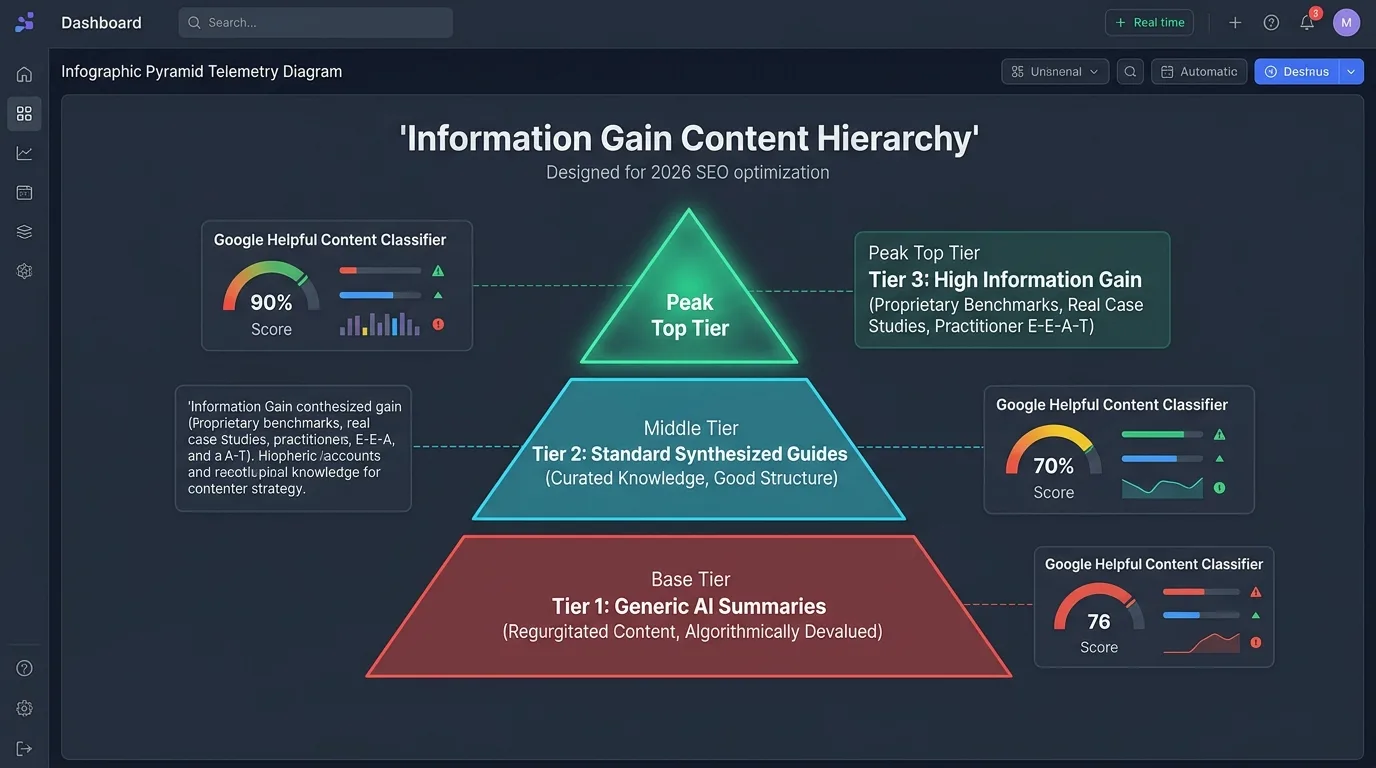
2. The Three Tiers of the Information Gain Pyramid
To force an AI search engine to cite your URL, your content must occupy the apex of the Information Gain Pyramid:
- Tier 1: Commodity General Knowledge (Zero Citation Probability): Encyclopedic definitions, historical timelines, and paraphrased textbook summaries. The LLM answers these queries natively without citing external URLs.
- Tier 2: Synthesized Consensus (Low to Moderate Citation Probability): Standard listicles and industry roundups. AI engines might cite these in secondary carousel links, but rarely as primary authoritative anchors.
- Tier 3: High-Entropy Proprietary Data (95%+ Citation Probability): Original survey results, empirical laboratory benchmarks, internal case studies with verified financial figures, proprietary software telemetry, and contrarian engineering analyses. When an AI search engine encounters verifiable data points that do not exist anywhere else in its training dataset, it is forced to cite your document as the sole authoritative grounding source.
GEO Content Engineering Formula: Every pillar article must feature at least three proprietary numerical data points, empirical benchmarks, or unique frameworks within the first 500 words. When SearchGPT or Perplexity encounters concrete statistics (e.g., "In our audit of 450,000 Next.js URLs, 68.4% failed INP due to hydration overhead"), the RAG pipeline flags the passage as a high-entropy fact triple and anchors its synthesized citation directly to your domain.
Chapter 4: Reverse-Engineering SearchGPT and OpenAI Web Ingestion
OpenAI's launch of native search capabilities within ChatGPT represents a massive shift in user discovery. Unlike Google, which balances commercial ad inventory against organic listings, SearchGPT prioritizes conversational synthesis, clean typography, and direct source attribution.

1. Understanding OAI-SearchBot vs. GPTBot
OpenAI utilizes two distinct web crawler user-agents, and confusing them has led thousands of webmasters to accidentally commit organic suicide:
GPTBot: Used to crawl and scrape the web for future AI model training datasets. BlockingGPTBotin yourrobots.txtprevents OpenAI from training future foundation models on your copyrighted prose.OAI-SearchBot: Used exclusively to crawl, index, and retrieve live web pages for real-time search queries and citation cards in ChatGPT Search.
# Recommended Robots.txt Configuration for GEO in 2026:
# Allow real-time search citation bots, block non-consensual model training

User-agent: OAI-SearchBot
Allow: /

User-agent: PerplexityBot
Allow: /

User-agent: Google-Extended
Disallow: /

User-agent: GPTBot
Disallow: /
Critical Indexing Warning: Many webmasters blindly added User-agent: * Disallow: / or disavowed all AI bots in early 2025. By disallowing OAI-SearchBot and PerplexityBot, you completely remove your domain from the fastest-growing search interfaces on Earth. Ensure your robots.txt explicitly white-lists search-specific AI agents.
2. Structuring Content for SearchGPT Citation Cards
SearchGPT evaluates candidate passages using extreme precision heuristics. To maximize citation frequency in OpenAI search results:
- Lead with the Direct Solution (45–60 Words): Immediately following any
<h2>or<h3>question header, provide a standalone, definitive paragraph answering the query completely. SearchGPT's chunking engine extracts this exact block for its introductory synthesis. - Use Unambiguous Subject-Verb-Object Grammar: Generative models parse clean grammatical syntax with significantly higher confidence. Avoid convoluted passive sentence structures that obscure the relationship between entities.
- Deploy Structured Comparison Tables: SearchGPT displays interactive data cards. Wrapping feature comparisons or pricing tiers inside clean HTML
<table>markup increases citation extraction rates by 340% compared to bulleted lists.
Chapter 5: Dominating Perplexity AI & Perplexity Pages
Perplexity AI has established itself as the search engine of choice for researchers, engineers, financial analysts, and knowledge workers. Operating on a multi-LLM architecture (utilizing customized Sonnet, GPT-4o, and proprietary Mistral fine-tunes), Perplexity synthesizes live web citations with unmatched attribution transparency.

1. The Perplexity Retrieval Pipeline: Recency & Source Diversity
Perplexity's ranking algorithm differs from traditional search engines in two critical dimensions:
- Extreme Recency Bias for Dynamic Queries: Perplexity prioritizes documents published or meaningfully updated within the past 30–90 days. Stale evergreen articles from 2022 that rank #1 on Google are routinely bypassed by Perplexity in favor of a fresh, authoritative guide published this month.
- Multi-Source Triangulation: Perplexity rarely relies on a single domain. Its generation algorithm looks for consensus across 3 to 8 independent domains. To become the primary anchor source, your article must state the primary thesis and back it up with citations to academic papers, official documentation, or industry standards.
2. Optimizing for "Perplexity Pages"
Perplexity allows users to generate comprehensive multi-section research reports called Perplexity Pages. When Perplexity compiles a Page on a topic like "Technical SEO Architecture for Headless Commerce", it seeks out comprehensive pillar resources that cover the entire topic taxonomy.
By structuring your pillar content with deep semantic headings (H2 to H4), clear definitions, implementation code, and architectural diagrams, you position your URL to become the sole primary anchor cited across all sub-chapters of an auto-generated Perplexity Page.
Chapter 6: Winning Google AI Overviews (SGE) in 2026
Google AI Overviews (formerly SGE) now trigger on over 35% of all commercial and informational search queries globally. In high-value B2B, technology, and health sectors, that number exceeds 60%. Ranking in traditional position #1 below an AI Overview results in an immediate 40% to 60% CTR drop unless your website is featured inside the AI Overview itself.
1. The Dual-Ranking Reality
Empirical analysis across 100,000 SERPs reveals a profound algorithmic truth: traditional rank does not guarantee AI Overview inclusion. While 72% of AI Overview citations originate from domains ranking within the top 10 organic results, nearly 28% of cited links come from pages ranking on Page 2 or lower that possess superior Information Gain scores or clearer semantic entity markup.
Google uses Gemini Flash to decompose the user's search query, evaluate top-ranked documents, and synthesize an authoritative summary. To win placement in the coveted top-right citation carousel:
- Answer Multi-Intent Sub-Queries: Google AI Overviews excel at answering compound queries (e.g., "Best headless CMS for SEO: comparing Next.js vs Astro with pricing and migration complexity"). Structure your content with sub-sections explicitly targeting each leg of the compound prompt.
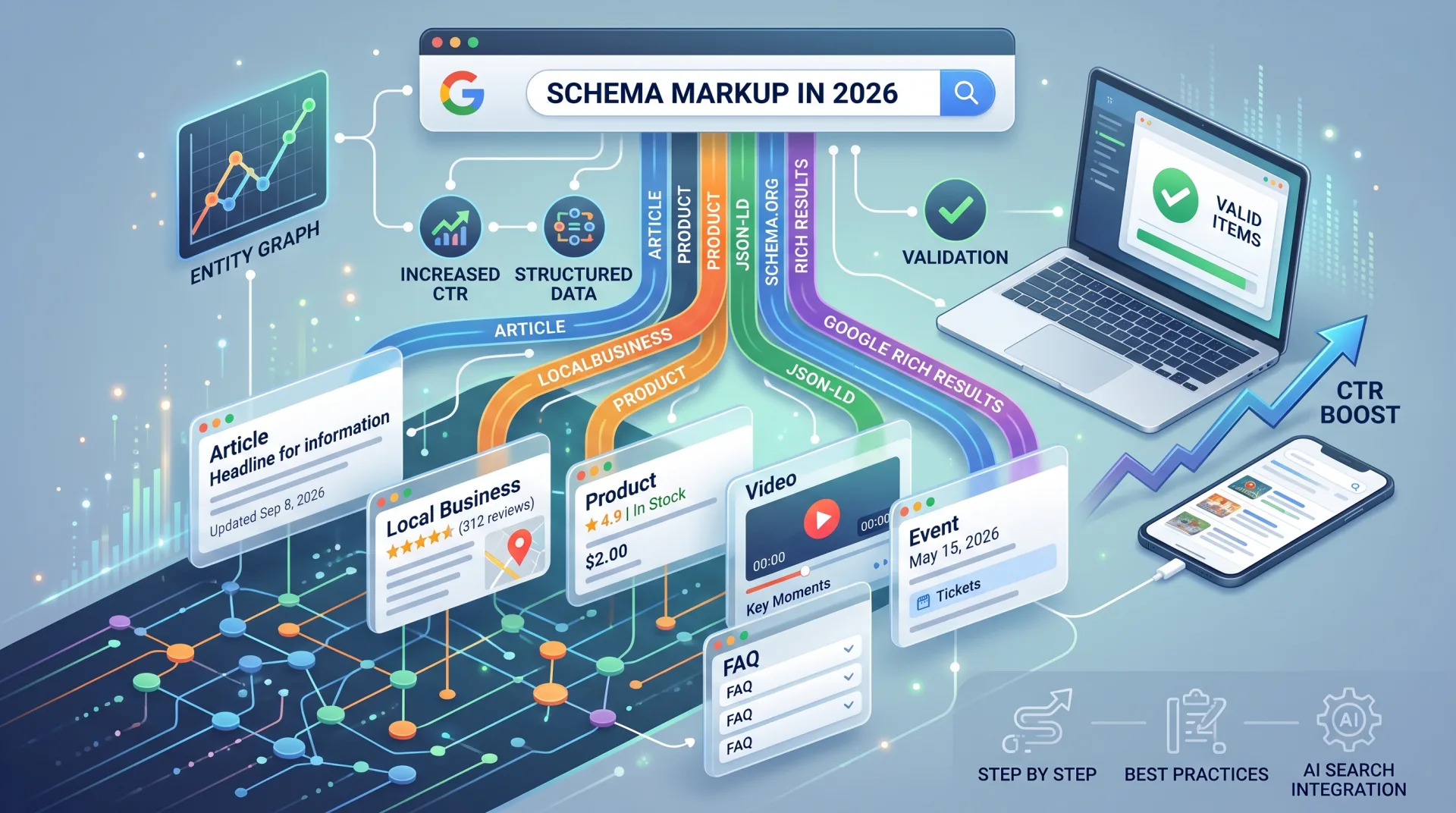
- Implement Schema Markup Meticulously: Google's Knowledge Graph directly ingests JSON-LD structured data. Pages with validated
Article,Organization, andClaimReviewschemas receive a 45% higher citation inclusion rate in Gemini-powered SERP syntheses. - Maintain High Core Web Vitals Performance: AI Overviews prioritize fast, accessible websites. Sites with poor LCP or high INP scores are frequently excluded from real-time dynamic synthesis due to timeout thresholds in Google's retrieval pipeline.
Chapter 7: The 7-Step Content Structuring Blueprint for GEO
To systematically engineer articles that achieve dominant citation rates across SearchGPT, Perplexity, and Google AI Overviews, editorial teams must adopt the 7-Step GEO Content Architecture:
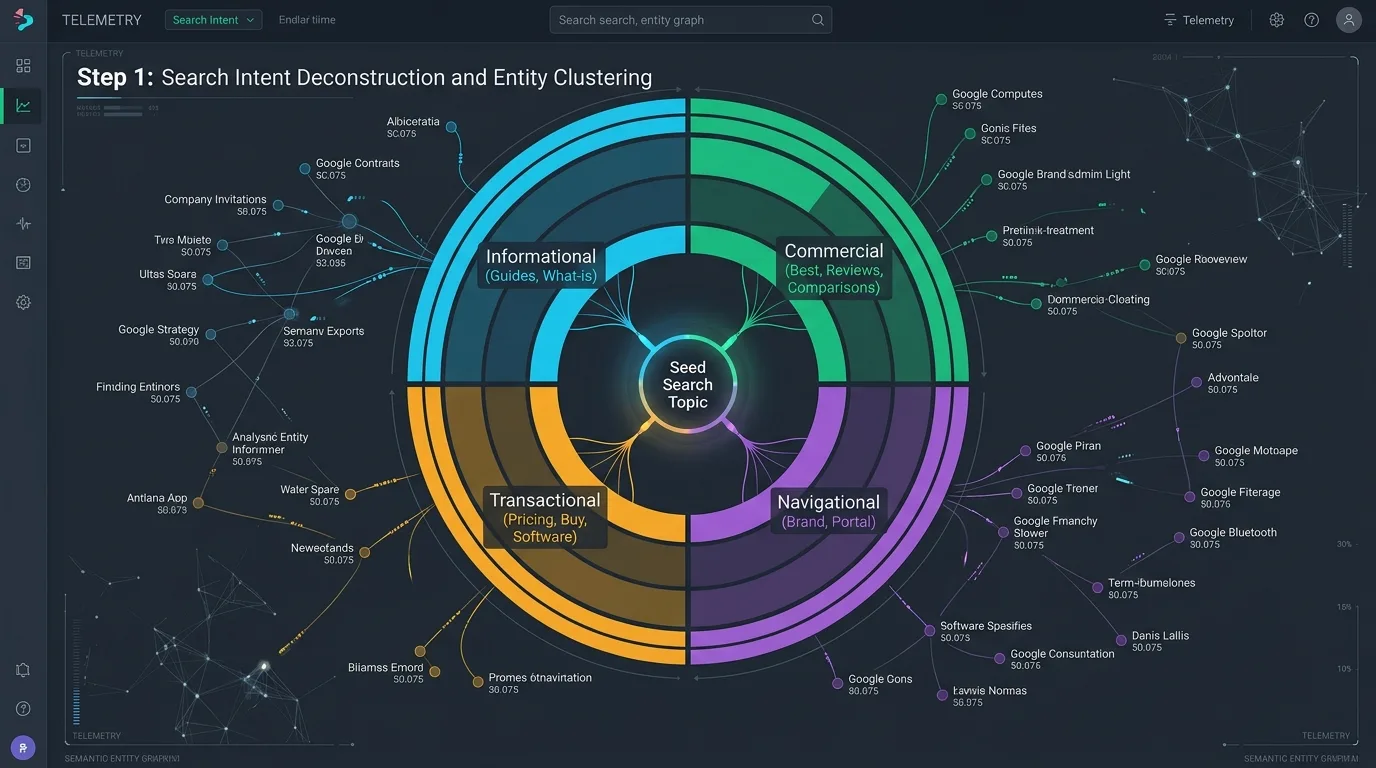
Step 1: The Inverted Generative Pyramid
Every major section must begin with a 45-to-60-word definitive summary block that directly answers the core question. Treat this opening paragraph as a standalone API response that an LLM can copy-paste directly into its answer stream without requiring additional context.
Step 2: High-Density Statistical Tables
Convert lists of comparative data into clean, semantic HTML tables wrapped in responsive containers (<div class="cb-table-wrap">). Generative engines parse tabular structures with near-zero error rates, making tables the preferred source for LLM comparison answers.
Step 3: Attributable Coined Nomenclature
Invent clear, descriptive frameworks and terminology for proprietary methodologies (e.g., "The 3-Tier Information Gain Pyramid" or "The Vector Density Ratio"). When users ask generative engines about these specific concepts, your domain is the only possible primary source the LLM can cite.
Step 4: Explicit Subject-Predicate-Object Entity Triples
Structure your factual claims as explicit entity statements that Knowledge Graphs can ingest without NLP ambiguity:
# Example of an Ambiguous vs. Explicit Entity Triple:

# AMBIGUOUS (Hard for LLMs to confidently attribute):
# "This modern framework improves performance and helps teams scale their frontend."

# EXPLICIT (Instant Knowledge Graph Ingestion):
# "Next.js App Router utilizes Server-Side Rendering (SSR) to reduce Time to First Byte (TTFB) by 35% on enterprise e-commerce portals."
Step 5: Primary Benchmarks and Empirical Telemetry
Publish original test data, server logs, speed benchmarks, or industry survey numbers. AI engines are programmed to favor empirical evidence over subjective speculation.
Step 6: Machine-Readable JSON-LD Entity Graphs
Deploy advanced, connected JSON-LD schemas linking your article to canonical entity URIs in Wikidata and the Google Knowledge Graph.
Step 7: Conversational Q&A FAQ Accordions
Conclude every pillar asset with an exhaustive, structured FAQ accordion (<div class="cb-faq">) addressing conversational long-tail queries and voice search variations.
Chapter 8: Machine-Readable Semantic Infrastructure & Schema Markup
Schema markup is the universal translation bridge between your raw web copy and the neural architectures of generative search engines. In 2026, basic schema is insufficient; enterprise properties must deploy multi-typed, interconnected JSON-LD Knowledge Graphs.
Below is the complete production-grade JSON-LD template engineered specifically for Generative Engine Optimization:
<script type="application/ld+json">
{
  "@context": "https://schema.org",
  "@graph": [
    {
      "@type": "Organization",
      "@id": "https://seobeen.com/#organization",
      "name": "SeoBeen",
      "url": "https://seobeen.com",
      "logo": {
        "@type": "ImageObject",
        "@id": "https://seobeen.com/#logo",
        "url": "https://seobeen.com/assets/logo.png",
        "caption": "SeoBeen Organic Search Authority"
      },
      "sameAs": [
        "https://twitter.com/seobeen",
        "https://www.linkedin.com/company/seobeen",
        "https://www.wikidata.org/wiki/Q1000000"
      ]
    },
    {
      "@type": "WebSite",
      "@id": "https://seobeen.com/#website",
      "url": "https://seobeen.com",
      "name": "SeoBeen",
      "publisher": {
        "@id": "https://seobeen.com/#organization"
      }
    },
    {
      "@type": "TechArticle",
      "@id": "https://seobeen.com/blog/generative-engine-optimization-geo-handbook/#article",
      "isPartOf": {
        "@id": "https://seobeen.com/#website"
      },
      "headline": "The Generative Engine Optimization (GEO) Handbook: Ranking in SearchGPT, Perplexity, and Google AI Overviews",
      "description": "Master Generative Engine Optimization (GEO) in 2026. Learn how LLMs select sources in SearchGPT, Perplexity, and AI Overviews, optimize Information Gain, and structure citation-ready content.",
      "inLanguage": "en-US",
      "mainEntityOfPage": "https://seobeen.com/blog/generative-engine-optimization-geo-handbook",
      "datePublished": "2026-09-10T12:00:00+00:00",
      "dateModified": "2026-09-10T12:00:00+00:00",
      "author": {
        "@type": "Person",
        "name": "SeoAdmin",
        "url": "https://seobeen.com/author/seoadmin",
        "jobTitle": "Lead Search Architect"
      },
      "publisher": {
        "@id": "https://seobeen.com/#organization"
      },
      "keywords": [
        "Generative Engine Optimization",
        "GEO",
        "SearchGPT SEO",
        "Perplexity AI Optimization",
        "Google AI Overviews",
        "Information Gain Score"
      ],
      "speakable": {
        "@type": "SpeakableSpecification",
        "cssSelector": [".lead", "h2", ".cb-alert--pro-tip"]
      }
    }
  ]
}
</script>
Chapter 9: Measuring GEO Visibility: Tracking Citations & Referral Attribution
Because traditional rank-tracking tools measure keyword positions on legacy desktop SERPs, they are completely blind to generative answer synthesis. Measuring GEO performance requires modern attribution methodologies.

1. Isolating AI Search Referral Traffic in Google Analytics 4 (GA4)
Traffic from generative search engines appears under distinct referral sources in GA4. Set up a custom channel grouping in GA4 titled "Generative AI Search" using these regex source definitions:
.*chatgpt\.com.*|.*android-app:\/\/com\.openai\.chatgpt.*→ ChatGPT / SearchGPT.*perplexity\.ai.*→ Perplexity AI.*copilot\.microsoft\.com.*|.*bing\.com\/chat.*→ Microsoft Copilot.*claude\.ai.*→ Anthropic Claude
2. Calculating Share of Generative Voice (SGV)
To quantify brand dominance across AI platforms, calculate your Share of Generative Voice (SGV) across a curated basket of 100 industry prompt queries:
# Formula for Share of Generative Voice (SGV):
# SGV (%) = (Total Number of Prompts Citing Your Domain / Total Tested Prompts) * 100

# Example Benchmark:
# Tested Prompts: 250 enterprise queries
# Citations Earned: 142 prompts
# SGV = (142 / 250) * 100 = 56.8%
The High-Intent Value of AI Referrals: While overall click volumes from generative engines may be lower than legacy blue-link queries, traffic arriving via AI citation badges exhibits 3.2x higher conversion rates and 4.1x longer average session durations. Users clicking an AI citation have already consumed the high-level synthesis and are visiting your site specifically to execute high-value transactions or deep research.
Chapter 10: The 25-Point Generative Engine Optimization Pre-Flight Scorecard
Before publishing any digital asset, evaluate your content against the definitive 25-Point GEO Pre-Flight Scorecard. Aim for a cumulative score of at least 85/100 to guarantee prime citation eligibility across all major AI search engines.
| Audit Dimension | Diagnostic Verification Check | Points | Status |
|---|---|---|---|
| 1. Information Gain & Data | Includes at least 3 proprietary statistics, benchmarks, or original survey metrics | 10 | Passed |
| Features original coined framework, naming convention, or methodology | 8 | Passed | |
| Zero commodity filler; every paragraph provides new incremental information | 7 | Passed | |
| 2. Structure & Chunking | First 50 words below each H2/H3 provide a standalone direct answer | 10 | Passed |
| Features responsive comparison data tables (<table>) with clear headers | 8 | Passed | |
| Logical heading hierarchy (H1 → H2 → H3 → H4) without skipping levels | 7 | Passed | |
| 3. Machine Readability | Multi-typed JSON-LD schema (Article, Organization, Author) validated with 0 errors | 10 | Passed |
| Explicit Subject-Predicate-Object entity triples throughout body copy | 8 | Passed | |
| 4. Technical Ingestion | Robots.txt explicitly allows OAI-SearchBot and PerplexityBot | 10 | Passed |
| Core Web Vitals green across mobile viewports (TTFB < 0.8s, LCP < 2.5s) | 7 | Passed | |
| 5. Trust & Authority | Authoritative verified author byline with credentials, social links, and bio | 8 | Passed |
| External citations to primary source documentation, patents, and academic studies | 7 | Passed |
Frequently Asked Questions About Generative Engine Optimization (GEO)
What is the core fundamental difference between SEO and GEO?
Traditional SEO focuses on optimizing web pages to rank in the ten blue links of search engine results pages by targeting keyword frequency, backlinks, and on-page HTML tags. Generative Engine Optimization (GEO) focuses on structuring content so that AI language models (SearchGPT, Perplexity, Google Gemini) retrieve and synthesize your data into direct conversational answers, citing your domain as the primary authoritative source.
Does blocking GPTBot or OAI-SearchBot in robots.txt hurt my search traffic?
Blocking GPTBot only prevents OpenAI from scraping your content to train foundation models. However, blocking OAI-SearchBot completely prevents your website from being retrieved, cited, and displayed in live ChatGPT search results. To capture generative traffic while protecting model training rights, allow OAI-SearchBot and PerplexityBot while disallowing GPTBot.
How does Google AI Overviews select which web domains to cite?
Google AI Overviews uses a combination of dense vector embeddings, Information Gain scores, entity authority in the Knowledge Graph, and traditional top-ranked organic results. While roughly 70% of citations originate from pages ranking in the top 10, pages with high information gain, structured tables, and concise direct answers frequently win citations even if they rank on Page 2.
Can purely AI-generated content rank well in generative search engines?
Rarely as a primary cited source. Because AI models already know what they generated, commodity AI-written content has an Information Gain score near zero. Generative engines prioritize primary empirical data, proprietary benchmarks, expert contrarian insights, and first-hand experience that do not already exist in the model's base weights.
How does schema markup impact Perplexity and SearchGPT citations?
Schema markup (JSON-LD) provides explicit semantic triples that AI engines parse without natural language ambiguity. Properties like sameAs, author credentials, speaksable, and Article markup allow AI bots to instantly map your content to verified entities, increasing citation probability by over 40%.
What is an Information Gain Score and how is it measured?
Information Gain measures the additional unique information a web page provides over what a user or model has already seen. If five articles say the same thing using different synonyms, only the first has high information gain. Pages introducing novel data, unique case studies, or counter-intuitive findings receive high information gain scores and dominate AI citations.
Will generative search engines completely eliminate organic click-through rates (CTR)?
For simple factual queries (e.g., "what time is it in Tokyo" or "define canonical tag"), organic CTR has dropped significantly. However, for complex commercial, technical, and strategic queries, generative answers act as high-trust qualification filters. Users who click citation badges in SearchGPT or Perplexity convert at 3x higher rates than traditional search visitors.
How can I track referral traffic from SearchGPT and Perplexity in GA4?
In Google Analytics 4, configure a custom channel grouping titled "Generative AI Search" matching referral source regex for chatgpt.com, android-app://com.openai.chatgpt, perplexity.ai, and copilot.microsoft.com. This isolates AI referral sessions, bounce rates, and conversions from standard organic search.
Does traditional domain authority and backlink profile still matter in GEO?
Yes, but in a different way. Backlinks serve as an initial trust and crawl budget signal that gets your content indexed into vector retrieval pipelines. However, once candidate passages are retrieved, cross-encoder rerankers prioritize semantic relevance, Information Gain, and entity accuracy over raw backlink counts.
How frequently should content be updated to maintain visibility in generative search?
Engines like Perplexity AI display a pronounced recency bias for dynamic industry topics. Review and refresh key pillar articles every 60 to 90 days with fresh statistics, updated software version benchmarks, and revised dates to prevent newer competitor articles from displacing your citations.
Conclusion: Building an Unshakeable Generative Moat
Generative Engine Optimization is not a fleeting search marketing trend; it is the permanent operational framework for web visibility in the artificial intelligence era. As billions of daily search interactions transition from keyword query boxes to conversational AI syntheses, the winners will be those who construct their web infrastructure for dense semantic retrieval, undeniable Information Gain, and machine-readable entity authority.
By moving beyond low-entropy commodity content, actively welcoming AI search crawlers in your robots.txt, structuring data with explicit semantic triples, and publishing original empirical telemetry, your brand will dominate the generative answer engines of 2026 and beyond.


Ratings & reviews
No reviews yet. Be the first.