
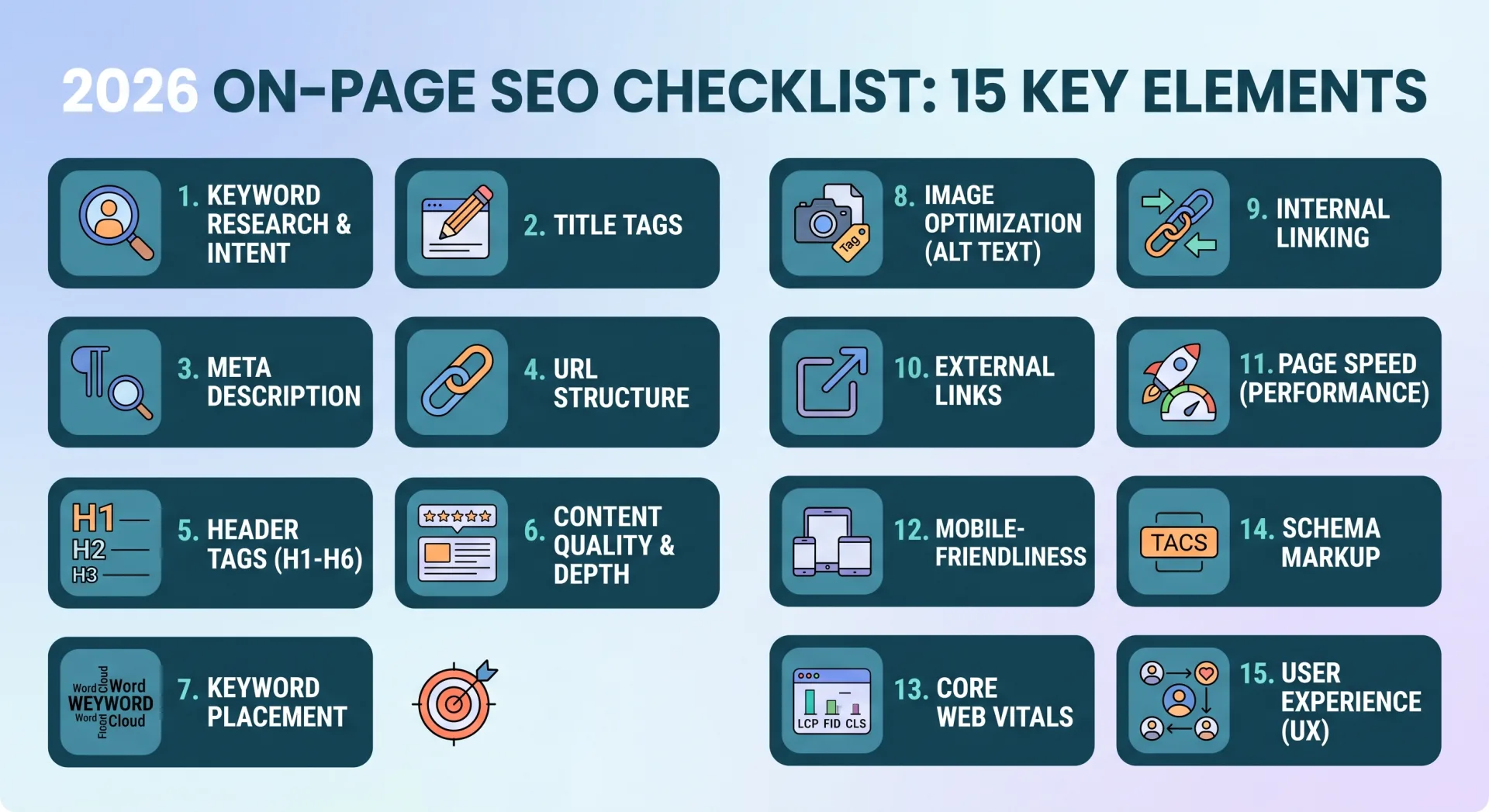
On-page SEO remains one of the most important foundations of organic search visibility in 2026. While search engines have become significantly better at understanding content, intent, entities, and context, the fundamentals of optimizing a page still matter.
A well-optimized page helps search engines understand what the content is about, which search intent it satisfies, and how different parts of the page relate to one another. More importantly, good on-page SEO makes the content easier to understand, navigate, and use.
This 15-point on-page SEO checklist for 2026 covers the most important elements you should review when creating or updating a page, from search intent and title tags to content structure, internal linking, images, structured data, and technical performance.
1. Match the Search Intent
Before optimizing keywords, headings, or metadata, make sure the page actually matches what users are looking for.
Search intent describes the underlying reason behind a search query. A user may want to learn something, compare options, find a specific website, or complete a purchase.
Common Types of Search Intent
- Informational: The user wants to learn or understand something.
- Navigational: The user is looking for a specific website, brand, or page.
- Commercial investigation: The user is researching products, services, or options before making a decision.
- Transactional: The user is ready to perform an action such as buying, subscribing, downloading, or booking.
Analyze the current search results before creating your page. Look at the types of pages Google consistently ranks, their content formats, major subtopics, and the questions they answer.
Your page does not need to copy the top-ranking results. Instead, use them to understand the dominant intent and then create something more useful, complete, clear, or original.
2. Optimize the Page Title and Title Tag
The page title is one of the most important elements for communicating the subject of a page. It also plays an important role in how users decide whether to click a result in search.
Create a title that accurately describes the page and naturally incorporates the primary topic when appropriate.
Best Practices for SEO Titles
- Clearly describe what the page is about.
- Write for humans first rather than search engines.
- Include the primary keyword or topic naturally when it fits.
- Make the title specific and useful.
- Avoid keyword stuffing.
- Differentiate the title from competing search results.
There is no universal character limit that guarantees a title will display completely in Google. Search engines may rewrite or truncate titles depending on the device, query, and available space.
3. Create a Clear H1 and Heading Structure
The main page title should clearly communicate the primary subject of the page. On most websites, the CMS or theme generates this title as the page's H1.
Inside the article body, use H2 headings for major sections and H3 headings for subsections. Use H4 only when another level of hierarchy is genuinely necessary.
Example Heading Hierarchy
<h1>Main Page Title</h1>
    <h2>Major Topic</h2>
        <h3>Supporting Topic</h3>
        <h3>Another Supporting Topic</h3>
    <h2>Another Major Topic</h2>
Do not use headings simply to make text larger or visually prominent. Headings should represent the logical structure of the content.
4. Optimize the URL
A clean URL helps users and search engines understand the general subject of a page.
Good URL Practices
- Keep URLs short and descriptive.
- Use words that describe the page topic.
- Use hyphens to separate words.
- Avoid unnecessary parameters when they are not required.
- Avoid excessive keyword repetition.
- Keep the URL stable once a page has established search visibility.
For example:
https://example.com/on-page-seo-checklist/A descriptive URL is preferable to an unclear URL containing unnecessary IDs or parameters.
5. Write a Useful Meta Description
The meta description is not a direct ranking factor, but it can help explain the page to searchers and influence whether they choose your result.
Write a concise description that accurately summarizes the page and gives users a reason to click.
Meta Description Best Practices
- Summarize the actual content of the page.
- Include important terms naturally when relevant.
- Communicate the value of the page.
- Avoid keyword stuffing.
- Do not write the same description for every page.
There is no fixed character count that guarantees a meta description will display exactly as written. Google may generate or rewrite the search snippet based on the query and page content.
6. Use Keywords Naturally and Cover the Topic Completely
Modern on-page SEO is not about repeating one keyword a specific number of times. Search engines can understand relationships between words, concepts, entities, and topics.
Instead of targeting keyword density, focus on covering the subject comprehensively and naturally.
Where Keywords Can Be Useful
- Page title
- Main heading
- Relevant section headings
- Introduction
- Body content
- Image alt text when the description genuinely requires it
- URL when appropriate
- Internal anchor text where relevant
Use synonyms, related terminology, entities, examples, and supporting concepts where they improve clarity. Never add keywords simply to increase their frequency.
7. Make the Content People-First and Comprehensive
Strong on-page SEO begins with useful content. A page should solve the user's problem rather than exist primarily to capture search traffic.
Ask yourself whether the reader can accomplish what they came to the page to do without needing to immediately search for another explanation.
Characteristics of Strong SEO Content
- Answers the primary question quickly.
- Provides useful depth where necessary.
- Uses examples and practical explanations.
- Avoids unnecessary repetition.
- Uses clear and readable language.
- Adds original value instead of simply rephrasing competing pages.
- Clearly distinguishes facts, recommendations, and opinions.
Longer content is not automatically better. The appropriate length depends on the topic and the amount of information needed to satisfy the user's intent.
8. Improve Content Readability and Scannability
Even excellent information can perform poorly from a user-experience perspective if it is difficult to read.
Break large sections into manageable paragraphs and use visual hierarchy to help readers scan the page.
Improve Readability With
- Short and focused paragraphs.
- Descriptive headings.
- Bulleted and numbered lists.
- Tables for structured comparisons.
- Examples and practical explanations.
- Bold text for genuinely important concepts.
- Clear transitions between sections.
A reader should be able to scan the page and quickly understand what information is available before deciding which sections deserve closer attention.
9. Optimize Images
Images can improve comprehension, demonstrate concepts, and make content easier to consume. However, poorly optimized images can also increase page weight and negatively affect performance.
Image SEO Checklist
- Use descriptive and meaningful file names.
- Compress images before or during upload.
- Serve appropriately sized images.
- Use modern image formats when appropriate.
- Add descriptive alt text when the image conveys meaningful information.
- Do not use alt text as a place to insert keywords.
- Use lazy loading for appropriate below-the-fold images.
For decorative images, an empty alt attribute can be more appropriate than adding unnecessary descriptive text.
10. Strengthen Internal Linking
Internal links connect related pages within your website. They help users discover additional information and help search engines understand relationships between pages.
Internal linking should be based on relevance rather than an arbitrary number of links per article.
Effective Internal Linking Strategies
- Link to closely related supporting content.
- Use descriptive anchor text.
- Link from authoritative pages to important pages when relevant.
- Build topic clusters around important subjects.
- Fix broken internal links.
- Avoid excessive or forced internal links.
For example, an article about on-page SEO could naturally link to related guides about technical SEO, keyword research, content SEO, internal linking, and structured data.
11. Use External Links Where They Add Value
External links can improve the usefulness of a page when they point readers toward authoritative sources, original research, documentation, or additional information.
Do not add external links simply because you believe every article needs a certain number of them. Link when the destination provides genuine value or supports an important factual claim.
Good External Linking Practices
- Reference authoritative and relevant sources.
- Link to original research when available.
- Use descriptive anchor text.
- Check important external links periodically.
- Use appropriate link attributes when required.
There is no SEO requirement that normal external links must open in a new browser tab. That is primarily a usability and accessibility decision.
12. Optimize Page Speed and Core Web Vitals
Page performance affects how easily users can access and interact with your content. Google also uses page experience signals, including Core Web Vitals, as part of its ranking systems.
For 2026, the three Core Web Vitals are:
- LCP: Largest Contentful Paint, which measures loading performance.
- INP: Interaction to Next Paint, which measures responsiveness to user interactions.
- CLS: Cumulative Layout Shift, which measures visual stability.
Common Performance Improvements
- Compress and properly size images.
- Reduce unnecessary JavaScript.
- Remove unused CSS and scripts where practical.
- Use browser and server caching.
- Improve server response time.
- Use a CDN when it makes sense for your audience.
- Prevent layout shifts caused by images, ads, or dynamically injected elements.
Do not optimize performance based only on a single Lighthouse score. Combine laboratory testing with real-user performance data when available.
13. Add Relevant Structured Data
Structured data provides search engines with machine-readable information about the content of a page. When supported and correctly implemented, it can make a page eligible for certain enhanced search appearances.
For example, depending on the page type, relevant structured data may include Article, Breadcrumb, Product, Organization, LocalBusiness, Recipe, Event, or other supported types.
Structured Data Best Practices
- Use structured data that accurately represents the page.
- Use the most appropriate supported Schema.org type.
- Ensure the marked-up information is consistent with the visible content.
- Keep structured data complete and accurate.
- Validate the implementation before publishing.
- Monitor Search Console after deployment.
Structured data does not guarantee a rich result or higher rankings. Its main SEO benefit is helping search engines understand eligible content and potentially display it in richer search features.
Also note that not every Schema.org type produces a Google rich result. For example, Google no longer displays FAQ rich results as a normal search feature, so FAQ markup should not be presented as a guaranteed way to obtain FAQ snippets.
14. Optimize for Search Features and SERP Visibility
Ranking in organic search is only part of the goal. Your result also needs to communicate value clearly enough to compete for attention on the search results page.
Depending on the query and page type, search results may include different enhanced features, including rich results, images, videos, product information, breadcrumbs, and other search features.
Improve SERP Visibility With
- Accurate and compelling titles.
- Useful meta descriptions.
- Clear content structure.
- Relevant structured data.
- Descriptive images.
- Strong topical relevance.
- Content that directly answers important questions.
Do not create content specifically to manipulate a search feature. First create a strong page, then make the information technically accessible and clearly structured.
15. Review, Update, and Monitor the Page
Publishing an article is not the end of on-page SEO. Search intent, competitors, facts, products, recommendations, and search features can change over time.
Important pages should be reviewed periodically to determine whether the information remains accurate and useful.
What to Check During an SEO Content Update
- Is the search intent still the same?
- Are the main facts still accurate?
- Are statistics and examples outdated?
- Are important subtopics missing?
- Are internal links still relevant?
- Are any links broken?
- Do images still provide value?
- Does the title accurately represent the current content?
- Is the page still technically accessible to search engines?
- Are there new competing pages offering a better answer?
Use performance data from tools such as Google Search Console to identify pages that may need improvement. Pay particular attention to changes in impressions, clicks, CTR, queries, and average position.
On-Page SEO Checklist: Quick Review
Before publishing or updating a page, use this condensed checklist:
- Search intent matches the page.
- Page title clearly describes the content.
- The page has a clear H1 generated by the CMS/template.
- Article sections use logical H2 and H3 hierarchy.
- URL is short, descriptive, and stable.
- Meta description accurately summarizes the page.
- Keywords and related concepts are used naturally.
- Content genuinely satisfies the user's needs.
- Content is easy to scan and read.
- Images are compressed and properly described.
- Internal links connect relevant pages.
- External links are used when they add value.
- Core Web Vitals and overall performance are addressed.
- Relevant structured data is implemented correctly.
- The page is monitored and updated when necessary.
What is schema markup?
Schema markup is structured data that uses a standardized vocabulary such as Schema.org to describe the content, entities, and relationships represented on a web page. Search engines can use this information to better understand the page and, when applicable, determine eligibility for enhanced search features.
Does schema markup improve Google rankings?
Schema markup should not be treated as a direct ranking boost. Its primary SEO purpose is to provide structured information that can help search engines understand content and can make eligible pages capable of appearing in supported rich-result experiences.
Can schema markup increase CTR?
It can potentially improve CTR when structured data leads to a more useful or prominent search appearance, but Google does not guarantee that an eligible rich result will appear. CTR should be measured using actual Search Console data.
Is JSON-LD better than Microdata?
JSON-LD is generally the preferred choice for modern implementations because it is easier to separate from the visible HTML structure and is typically easier to maintain. Google also supports Microdata and RDFa.
Should every page have schema markup?
No. Structured data should be used when it accurately describes the page and its entities. The correct approach is to implement schema according to page type and relevance rather than adding markup to every page simply for SEO purposes.
Is FAQ schema still useful for Google rich results in 2026?
You should not use FAQ schema expecting the old Google FAQ rich-result treatment. Google removed that Search feature in 2026. FAQ content itself can still be useful to readers, but it should not be treated as a guaranteed rich-result or CTR tactic.
Does valid schema guarantee a rich result?
No. Valid structured data can make a page eligible for a supported rich result, but Google decides whether and when to display the enhanced search appearance.
How can I test my schema markup?
Google's Rich Results Test can be used to check eligibility for supported rich-result features. The Schema Markup Validator can also be used to validate Schema.org structured data more generally.
What is the most important schema markup best practice in 2026?
The most important practice is accuracy. Your structured data should accurately describe the visible content and entities on the page, use an appropriate schema type, follow Google's current feature requirements, and be maintained as the page changes.
Final Thoughts
Effective on-page SEO in 2026 is less about following a rigid list of keyword placement rules and more about creating pages that are genuinely useful, technically accessible, clearly structured, and aligned with search intent.
Use this 15-point checklist as a quality-control process rather than a formula. Start with the user's needs, make the content comprehensive enough to solve the problem, organize it logically, optimize the technical elements, and use performance data to identify opportunities for improvement.
The strongest on-page SEO strategy is ultimately the one that brings together search intent, useful content, semantic clarity, internal linking, technical quality, performance, and continuous improvement.
Ratings & reviews
No reviews yet. Be the first.